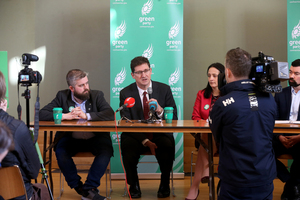
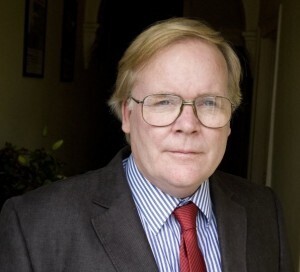
 From top:, Leader of the Green Party Eamon Ryan (centre), speaking to the media at the party’s last press conference before the vote in General Election 2020; Michael Taft
Just because climate chaos didn’t feature much in in the campaign doesn’t mean that it shouldn’t feature prominently in a Programme for Government. A Green New Deal is absolutely essential. And it will cost.
How much?
The National Development Plan (NDP) committed an additional €750 million per year over a 10-year period from the Exchequer. This was before the crisis became a major political topic – before the Interdepartmental Panel on Climate Change’s warning we have 15 years to turn things around and the international school strikes.
Indeed, the Climate Action Plan made a virtue of not committing resources:
“While the plan sets out a major programme of change, this cannot be approached as a call for a new programme of spending for the Exchequer to meet.”
Instead it relies on the funding envelope contained in the NDP. We will need considerably more than what is allocated to ‘turn things around’.
So without getting into the specific content, let’s look at how we can finance a transformative Green New Deal. And let’s estimate the expenditure at €10 billion over a five-year period (the amount and the period is not the key point of this post – merely where we can access the funding).
In showing how we can finance a special investment programme we need to consider the following.
First, any Green New Deal must be additional to what the Government has already proposed to spend in the ten-year NDP. Any attempt to ‘repackage’ or double-count spending will hopefully be exposed as a manipulative PR exercise.
Second, is the spending a once-off or does it commit the Government to continuous spending. Example: is the €200 million earmarked for a once-off public transport project (once built it doesn’t need to be built again)?
Or is it an ongoing expenditure such as subsidies to public transport to reduce fares? Ideally, a Green New Deal should be earmarked for capital projects but this needn’t be an iron law.
Third, is the expenditure a commercial investment and, therefore, not a charge on the Exchequer? For instance, Bord na Mona management once had an expansionary vision of a transition to sustainable business activity such as resources recovery, wind energy, biomass, environmental products, district heating and eco-tourism, encapsulated in its New Contract with Nature.
As these would have been commercial ventures, state investment would be ‘off-the-books’ (recently, however, Bord na Mona management has adopted a downsizing strategy wherein redundancies are described as investment in decarbonisation).
Another example of commercial activity would be a public stake in a consortium to build large-scale offshore wind farms. Being a commercial activity, the investment would not be a charge on the Exchequer. Commercial investments would be part of a Green New Deal but would not be a cost.
Fourth, all expenditure creates new revenue streams – either tax revenue or national income. For instance, providing free retrofit for households would be a significant upfront cost to the state.
However, the state would recoup the expenditure through a number of sources: repayments based on income or energy savings, the construction activity (income tax, etc.), household savings spent in other non-energy areas, reduction in fossil-fuel imports, reduced EU fines, etc.
Identifying revenue streams is important to costing a Green New Deal because there is a tendency to assume that €10 billion investment means that our national debt would rise by €10 billion. It doesn’t.
The impact on the national debt would be much less and, in the long term, would save money compared to the scenario where there was no investment.
Taking all this into account, where could we find €10 billion in a fiscally-efficient way.
First, the government is planning an accumulated surplus of €24 billion out to 2025.

This surplus is not required under the fiscal rules. In fact, those rules would allow us a deficit in each of these years though that is probably not advisable. However, a slightly lower accumulated surplus to fund a green investment programme is.
Second, we will have considerable cash balances (i.e. savings) out to 2023 and in all likelihood beyond. These are cash and assets available to the Government. In the years 2021 to 2023, cash balances will average €24 billion annually. It is doubtful that a small reduction in our ‘savings’ will have any negative impact on a finances which are firmly in the black.
Third, we could borrow money through Green bonds. With interest rates at rock-bottom (so rock-bottom that many of the bonds are selling at negative yield), the market is essentially paying us to borrow. So we can start racking up the finance now at almost no cost over the next 10 years.
Fourth, reduce the tax cuts proposed in manifestos. Fianna Fail proposed approximately €2 billion in tax cuts; Sinn Fein proposed €2.4 billion while Fine Gael proposed €3 billion.
From these four sources (and this doesn’t include rainy day funds), we have the ability to finance a Green New Deal.
Indeed, the financing is probably the easy part. The hard part would be finding the capacity to implement the programme. It is already questionable whether we have the labour to launch a major housing construction programme. A major retro-fit programme might run into severe bottle-necks for the simple reason that we don’t have the labour.
However, if any new Government wants to be taken seriously it will have to substantially increase the investment into climate justice over its lifetime – whether they call it a Green New Deal or something else.
If it’s not there in the big or fine print of a new programme then we will know that status quo succeeded and references to ‘change’ are just so much green-washing.
Michael Taft is a researcher for SIPTU and author of the political economy blog, Notes on the Front. His column appears here every Tuesday.
Rollingnews