This evening.
“RTÉ is very mindful it has a duty to the public to reflect events as they unfold.
During the course of the campaign and over recent days RTÉ has taken into consideration the notable change in the dynamic of the campaign on the ground, and representation and statements by political parties.
The dynamic has also been consistently reflected in all opinion polls since the campaign commenced.
We now consider it necessary to amend our original approach, respond to the changes in the campaign, and continue to put the audience first in the making of Tuesday night’s programme.”
RTÉ statement this evening.
Mary Lou McDonald to take part in leaders’ debate (RTÉ)
Earlier…

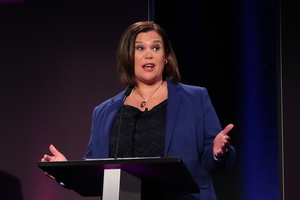
David McCullagh and Miriam O’Callaghan of RTÉ’s Prime Time; Sinn Fein leader Mary Lou McDonald, during the seven way RTE leaders debate
On January 14 last, Taoiseach Leo Varadkar announced that the election would take place on Saturday, February 8, 2020.
The following day, January 15, RTÉ released a press statement announcing details of its TV election debates. It noted:
“In the final days of the campaign The Prime Time Leaders Debate will see the party leaders from the two largest political parties invited to take part in a live head-to-head studio debate.”
“In approaching election coverage the RTÉ Election Steering Group has regard to objective and impartial criteria, such as the results of the last comparable election (in this instance, the General Election 2016) and the results of intervening elections, such as the 2019 Local and European elections. Other factors are also considered in RTÉ coverage of the campaign.”
This morning.
RTÉ’s Political Correspondent Paul Cunningham reports:
“RTÉ’s General Election steering committee will meet at 11am to consider representations from Sinn Féin for Mary Lou McDonald to participate in the Prime Time leaders’ debate tomorrow night.
“Under the existing plan, the debate will be between the Fine Gael leader Leo Varadkar and the Fianna Fáil leader Micheál Martin.
“Sinn Féin’s Pearse Doherty, who made the request to RTÉ in person yesterday, has argued that recent opinion polls prove that the criteria used to exclude Ms McDonald are redundant.”
More as we get it.
Meanwhile…

Prime Time presenter Miriam O Callaghan with, from left: Micheál Martin of Fianna Fáil, Enda Kenny of Fine Gael and Eamon Gilmore of The Labour Party before a three-way leaders’ debate during the 2011 General Election
From the book Electoral Management: Institutions and Practices in an Established Democracy: The Case of Ireland by Fiona Buckley and Theresa Reidy…
In a chapter by Kevin Rafter:
Televised leaders’ debates have been a feature of Dáil elections since February 1982 with the sole exception of the 1989 election when agreement was not reached to organise a debate.
The seven debates between February 1982 and May 2007 shared several common features. In the first instance, participation was confined to the leaders of Fianna Fáil and Fine Gael, the two largest parties, which in effect turned the encounters into ‘Prime Ministerial debates’ as holder of the office of Taoiseach (Prime Minister) have been drawn from these two parties.
In addition, there was always only one televised debate per campaign, and all these debates were hosted by RTÉ.
The nature of the leaders’s debate changed in the 2011 general election. The number of debates increased to four while the number of host broadcasters increased to three with the involvement of TV3 and the publicly owned Irish language service, TG4.
The debate on TG4 took place in the Irish language (all earlier debates were in the English language).
Finally, and undoubtedly the most important change in 2011 was an increase in the number of participating party leaders.
The leader of the Labour Party, traditionally the third largest party participated in all four debates while one of the debates was a five-way encounter involving all parties with a minimum representation in the outgoing Dáil.
Since 1988, the organisation of presidential debates in the USA has been overseen by an independent commission although they are still defined by ‘behind-the-scenes arguments about everything from the format of the questioners to the length of the response time, the placement of cameras, the height of podiums, and the location of water glasses’.
In an Irish context, these ‘debates about the debates’ involves private interaction between the main political parties and broadcasters. At the 2011 general election, each of the three broadcasters ultimately involved in broadcasting debates (RTÉ, TV3 and TG4) negotiated separately with the five main political parties. This was a different approach to the UK experience where the broadcasters ‘communicated and agree a concerted approach’.
RTÉ’s hosting of two leader debates in 2011 was preceded by eight months of informal conversations, email communication and formal face-to-face meetings.
In a post-election review, one RTÉ executive offered advice for colleagues involved in future debate negotiations:
“…avoid getting drawn into lengthy discussions on formats or rules and regulations – we make the TV, they provide the candidates – and at no stage did we get drawn into the sorts of intricate rules which were a feature of the UK debates.”
...The importance of being impartial and fair, and being seen to be so, was a central feature of RTÉ’s approach to election coverage in 2011.
Indeed, at the final internal SC [steering committee] meeting before polling day it was noted ‘with satisfaction that RTÉ’s coverage hadn’t featured as an election story and this was very welcome as an indication that we were providing extensive, accurate and fair coverage’.
There you go now.
RTÉ committee to meet over Sinn Féin participation in election debate (RTÉ)