

Ideal for trips.
MotoVehicleMovers writes:
John Lennon’s Rolls Royce Phantom V alongside George Harrison’s Mini-Cooper S Happy…
Imagine no jammers.



Ideal for trips.
MotoVehicleMovers writes:
John Lennon’s Rolls Royce Phantom V alongside George Harrison’s Mini-Cooper S Happy…
Imagine no jammers.

Join Me In The Pines – Feels So Heavy
It came from outer space…
Bell X1‘s Dave Geraghty (top) loves a bit of homegrown retro sci-fi as he delves deep into the Irish Film Institute’s archives for his new Join Me In The Pines video which features clips from County Down filmmaker Roy Spence‘s 1975 feature Keep Watching The Skies.
Dave says:
“I was attending a documentary film festival as I had scored the music for one of the shorts. As part of the programme, there was a documentary about Roy and his film work. Upon seeing this, a light-bulb went on in my head. Roy’s pictures and my music could work brilliantly together. So, I edited his twenty-minute film into a narrative that works beautifully with ‘Feels So Heavy’.”
The result is vintage Irish sci-fi soundtracked by Dave’s funkadelic soul. Nice.
The song can be found on the album Monomania. The single launch is in Bloody Mary’s in Dublin on February 29.
Nick says: Scream a little scream…

This morning.
Liberty Hall, North Dock, Dublin 1
People Before Profit’s Richard Boyd Barrett (left) and Brid Smith launch the party’s “Charter of Workers Rights” at the James Connolly Memorial Statue.
The charter proposes a shorter working week, a living wage of €15 an hour, mandatory sick and maternity pay on the full rate, union recognition for all workers and a right to strike.
Mr Boyd Barret said:
“Our workers are the most productive of anywhere in the Western world with the highest levels of productivity, but they have the lowest share of the national economic cake
We have one of the youngest populations anywhere in Europe and the plan of both Fine Gael and Fianna Fáil, I’m fearful, is to have us working longer than any other worker in Europe, before they are entitled to their pension and that doesn’t add up
I think there is a historic shift happening in Irish politics away from the two party system of Fianna Fáil and Fine Gael with a majority of people looking for an alternative.”
Meanwhile…
After outlining their Charter of Workers Rights, Bríd Smith entertained the gathered media singing a verse of “James Connolly“.
People Before Profit propose shorter working week and longer holidays (RTÉ)

This afternoon.
Bawnogue, Deansrath Estate, Clondalkin, Dublin 22.
Sinn Féin President Mary Lou McDonald with Dublin Mid West candidates Eoin Ó’Broin (right) and Mark Ward (left) urging the freezing of rents to alleviate the housing crisis.
Ms McDonald said recent polls “reflects the energy and momentum for Sinn Féin and for change”.
Meanwhile…

This afternoon.
The Irish Architectural Archive, Merrion Square Dublin 2.
Above from left: Labour Party Leader Brendan Howlin, Housing spokesperson Jan O’Sullivan and Duncan Smith, candidate for Fingal, launch the party’s General Election 2020 housing strategy, which includes a proposed rent freeze.
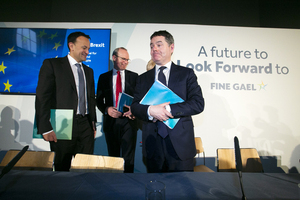
From top left to right: Leo Varadkar, Simon Coveney and Paschal Donohoe at the launch of Fine Gael’s General Election 2020 manifesto; Derek Mooney
Success has many fathers, defeat is an orphan. As true as this is in sports, it is an absolute certainty in political campaigning.
Have no doubt that all those fine young marketing executives who told their colleagues over Christmas how remarkably close they were to the Taoiseach and Fine Gael, now struggle to remember just who Leo, Paschal or Simon might be.
In the words of the great yellow rose of Finglas, Jim Tunney, there are too many folks around politics who opt to buy their colours coming out of the match, rather than going in.
So, before I look at the events of the last few days and attempt a feeble look forward to what may be to come, let me raise a glass to toast those in all parties and none who are sticking by their party and candidates, despite the polls.
I may have mentioned this story before, but during the 2013 Seanad abolition referendum I read an opinion piece in one of the national newspapers by a PR person, who I hadn’t heard of then and I haven’t heard of since.
He was critiquing our vote No to abolition campaign. Though he took over 750 words to do it, his analysis basically said: these people are going to lose because they never asked him what to do. Though I was confident of our campaign and messaging, his article really got under my skin. So much so that over six years later I am still moaning about it!
So, remembering how I felt then, I will not try to criticise or second-guess the strategies and decisions of those running the major campaigns. I am sure that none of them sat down a few months back and thought: how can I design a campaign that turns away our potential voters.
The von Moltke maxim applies as much to political as military campaigning: no battleplan survives with any certainty beyond the first direct engagement with the enemy.
The world is full of backseat drivers, hurlers on the ditch, Monday morning quarterbacks and various assortments of folks none of who have never lost a game because not a single one of them has ever played one.
What I will do instead today is to look back at how I thought the campaign would go – and see (a) what I got wrong, and (b). consider how that impacts on the way(s) I see things playing out from next Monday or Tuesday onwards.
For most of the last 18 months to 2 years I have been talking about the opinion poll trend showing the combined Fianna Fáil and Fine Gael support running at anywhere between the mid 50s or sometimes even heading as high as 60%.
As the two parties had a combined total support of just under 50% in 2016, I took the trend to the mid 50s as a sign of a modest growth in the centre ground of Irish politics – indeed you could broaden that definition of the centre ground by adding in the Greens and Labour.
I had thought that a big part of this election would be about how about how that 55% divided between Fianna Fáil and Fine Gael – and I felt reasonably confident that this would see Fianna Fáil hitting 30% or even a point or two higher.
That prediction was based on my long held and expressed belief that the Leo bounce of late 2017/2018 and early 2019 was more down to Brexit than any public faith or confidence in his leadership. I further felt sure that Fine Gael would approach this election with overconfidence and run a campaign that misread the public mood.
On these latter points I think I was proven right. On the capacity of the two main parties to rebuild the centre ground of politics to a modest level of 55%, I was wrong.
In my defence, I was not the only getting that bit wrong.
It seems Sinn Féin broadly agreed with me. Though they had confidence in their capacity to hold on to their 2016 vote share, despite the hammering they received at the 2019 local and European elections, their decision to run just 42 candidates in this election suggests a party strategy more focused on consolidation and modest growth, rather than one predicated on big breakthroughs and surges.
It could well be that they are right and the polls are still over-estimating their possible performance on the day but, even so, there is something happening at this election.
Thee question therefore is: how many seats will Sinn Féin add to its 2016 total? Will it be in single digits, or is a double digit seat increase on the cards? I have one spreadsheet prediction that has them on 34 seats.
As I discussed last week , the mood for change is real and palpable. Sinn Féin speaks directly to that mood while Fianna Fáil struggles to do so with clarity. What is beyond doubt is that Fine Gael cannot represent that change. So, any chance of a last minute Fine Gael resurgence is ruled out, meaning that the most likely micro-outcome of the election is a depleted Fine Gael heading to the opposition benches.
So who ends up in government, assuming the polls are broadly right?
There is no appetite in Fianna Fáil for a grand coalition. Fianna Fáil is having a tough enough time convincing a significant cohort of voters aged 25+ that it represents change, how much worse would its task be at the next election if the outcome of this one was Mícheál Martin aiding and abetting the return of rejected Fine Gael ministers to Cabinet.
Similarly, a Fianna Fáil/Sinn Féin coalition is a non-runner. Martin has been absolutely clear that he would not agree to such a coalition.
Whatever level of support Fianna Fáil secures next weekend, be it 25%, 26%, 27% or higher (full disclosure I think it will be around 26/27%)… will have been won, in part, on the basis that Fianna Fáil will not go into government with Sinn Féin.
It is absolutely not impossible for Fianna Fáil to do a volte-face. After all, politics and government formation is all about numbers, but the price it would pay at any following election would be significant.
Wiser, calmer heads in Fianna Fáil know that the life span of any FF/SF government would be determined solely by Sinn Féin. At the first sign of trouble or of difficult decisions Sinn Féin would have no compunction about cutting and running.
This is not just a theoretical concern, bear in mind that it is likely there will be some form of economic downturn due soon, be it Brexit related or global.
If you think I am just being cynical or blinkered by my acknowledged dislike of Sinn Féin, see how Sinn Féin handled the welfare crisis in the North.
Faced with deeply unpopular decisions on welfare cuts, Sinn Féin, the ultra-republican party that rejects British rule and finds any form of presence at Westminster an anathema, voted along with the DUP to hand the welfare powers that had been devolved to it, back to Westminster. Not just to Westminster, but to one dominated by a Tory government that would impose swingeing cuts. This is before you even look at the three year government hiatus it triggered.
So, having ruled out a grand coalition of FF and FG or a coalition of FF and SF, what remains?
I think it is a Fianna Fáil/Green government with outside Fine Gael support via a less restrictive C&S than Fianna Fáil had to endure.
The Greens and Fianna Fáil may want others involved, such as Labour, Soc Dems or even some independents but that looks unlikely right now. Even so, the core of such a minority government would be Fianna Fáil and the Greens.
This would be Sinn Féin’s least preferred option.
It would be very satisfied with a FF/FG grand coalition that made it the main opposition party, just as it would be happy with a FF/SF coalition. It would also be happy with stalemate and a second general election. This is not an option that can be ruled out, either.
Sinn Féin has almost nothing to lose in any three of these four scenarios. As Sherlock Holmes used to say, when you have ruled out all the impossible option, then whatever remains, no matter how improbable, is the solution.
It may take a few weeks, but watch that space.
Derek Mooney is a communications and public affairs consultant. He previously served as a Ministerial Adviser to the Fianna Fáil-led government 2004 – 2010. His column appears here every Monday.Follow Derek on Twitter: @dsmooney


Behold: the FT750-26 and FT750-20, two e-bikes from the California Scooter Company.
A 750-watt hub motor gives a top speed of 32km/h and 64km of range with a full charge of the 13.6-Ah battery. The two models have slightly different frame sizes with 26” and 20” tyres respectively, but both have an LED status display on the handlebar, fat Kenda tyres and 10cm of travel on the telescopic front fork.
Yours for about €1,520.
UPDATE: CSC don’t ship electric bicycles outside of the US so you’d have to make some class of alternative arrangement if you want one. (Thanks Michael)


This afternoon.
Mount Street, Dublin 2.
Members of Extinction Rebellion protest over climate change by spraying green paint on the entrance to Fine Gael HQ.


This morning.
Fine Gael Generel Election HQ.
Above from left: Minister for Finance, Public Expenditure and Reform, and Fine Gael Director of Elections, Paschal Donohoe, Marcella Corcoran Kennedy, Fine Gael candidate for Laois-Offaly, and member of the Oireachtas Committee on Climate and Minister for Communications, Climate Action and Environment Richard Bruton set out their party’s climate action plans .
OF recent polls, Mr Donohoe said:
“Fianna Fail are putting forward their worst hits of their recent past and what Sinn Fein are offering is the kind of ideas that will do such harm to workers income, to wages and to their jobs.
“They have claimed they are going to put forward new ideas for investment involving 15 different tax hikes – tax hikes that would be bad for those at work, tax hikes that would be bad for those looking to create jobs.”
Meanwhile….


This morning.
Fianna Fáil General Election 2020 HQ, Dublin.
Fianna Fáil Finance Spokesperson Michael McGrath (above left) and Health Spokesperson Stephen Donnelly begin the last week of the General Election campaign.
Of Sinn Fein’s poll rise, Mr McGrath said:
“In the real world, people change their behaviour, they make investment decisions depending on the change in taxation and enterprise landscape in the country.
“Sinn Fein want to make this a very cold place for business. They want to tax employment through increasing PRSI (Pay Related Social Insurance), they want to tax people over 100,000 euro under the pretence that won’t affect anybody below 100,000 euro.”

Sure.
Sexist pig.
This afternoon.
Kildare Street, Dublin 2
Members of Active Retirement Ireland and Age Action brew up outside the Dail as they call for parties in the General Election to appoint a senior minister for older people and ensure pension reform:
‘We want the next Government not to introduce the planned increase in the pension age to 67 in 2021 and 68 in 2027 because of the disjointed and poor approach to planning which is disproportionately impacting on older people.’
Put Older People at the Heart of the Next Government (Active Retirement Ireland)
