



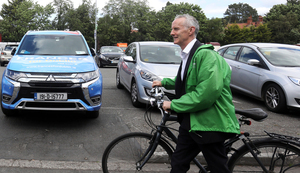
 From top: Green Party’s Ciarán Cuffe arrives at the European elections count centre at the RDS, Ballsbridge, Dublin 4 yesterday; Bryan Wall
With the election results all but in, now comes the time for a post-mortem. The left vote has collapsed to large degree. Sinn Féin has lost the gains it made in the last few years and parties farther to the left have not been able to capitalise on the failures of Fianna Fáil and Fine Gael.
Instead, the Greens are the main winners right across the country.
Many are lauding this as proof of a greater awareness amongst Irish people of the challenges facing the country when it comes to climate change.
Perhaps there’s a realisation that all the other parties have failed to do anything about climate change. And now the Greens have stepped into the fold with a mixture of the right ideas and the right people to do something about it.
Their electoral success should be seen as a protest vote more than anything else. The Greens are far enough from Fianna Fáil and Fine Gael that there is a difference between them in the minds of some people. This makes voting for them palatable.
But the simple truth is that the Greens have more in common with the big two than with any of the parties to the left.
Having spent the last decade in the political wilderness, this has been forgotten or is simply not known by a generation of voters going to the ballot box for the first time.
When the Greens were in coalition with Fianna Fáil their record was, quite simply, atrocious. As the Shell to Sea campaign noted, when the Green’s current leader, Eamon Ryan, was a minister in the coalition with Fianna Fáil, he was happy to “impose” the Corrib gas project. Ryan, they said, “mobilis[ed] hundreds of Gardai and the Navy in order to do so”.
Former Green Party leader John Gormley, who was leader while they were in power with Fianna Fáil, stood by his party’s support of the bank guarantee. He argued in 2009 that “If we had not acted, the costs to the economy would be incalculable and that is why we had to act”. Although he later claimed that he was reliant on bad advice from experts.
Nonetheless, during his time in coalition he defended the austerity budgets he helped to impose on the basis that it was in the “national interest”. And during the banking inquiry he insisted that:
“Every one of those austerity budgets was progressive. In other words, each budget hit the wealthier members of our community proportionately harder than the less well-off.”
According to a prominent Irish activist, before getting into government, Gormley was also known to regularly attend meetings of the Irish Anti-War Movement and was “gung-ho” about Palestine. But they noted that as soon as Gormley went into coalition with Fianna Fáil, “that was the last we heard of such things”.
And current Green Party star Ciarán Cuffe was more than happy to hob-knob aboard the USS John F Kennedy aircraft carrier when it visited Dublin in 1996 while he was a member of the Dublin City Council. As The Phoenix noted, he did this while members of his own party were picketing the presence of the US ship.
This brief and incomplete history of the Greens is telling and all the more given Eamon Ryan’s comments while counting of the ballots was still ongoing over the weekend.
During an interview on Newstalk, he apparently refused to be drawn on whether or not his party would go into coalition with Fianna Fáil or Fine Gael.
His defence was that:
“Every party increasingly in our system vote to agree internally to go into power or a Programme for Government”.
In another interview he told the Irish Times that he could see the Greens being part of “rainbow coalition with a range of different parties”. Cuffe refused to be drawn on this when questioned by journalists.
Fellow star of the party, Saoirse McHugh, has been more forthright, however. She said “Yeah” when asked if she would resign from the party if it entered into a coalition with either of the big two.
Cuffe argued that the idea of a coalition was “hypothetical” but nonetheless said, “Let’s see how things go today and then we can have a look at all these issues”.
Although McHugh seemed put out being asked about a possible coalition with Fianna Fáil or Fine Gael, saying “I don’t know why everyone keeps talking about it” as no general election has been called, it appears that her seniors have begun planning for the possibility.
Both Ryan’s and Cuffe’s comments are indicative of this. And, probably more importantly, it appears that Fine Gael has begun setting the stage for the Greens to go into a coalition with them.
Varadkar has said an early general election is possible. This is probably a greater possibility than ever before now that the Greens have shown their willingness to at the very least consider going into government with Fine Gael.
Hoping that the Greens’ local and European electoral success will translate into Dáil seats, he likely realises he can use them to prop up his party in the aftermath of an election in which Fine Gael would inevitably lose some seats.
The political courting has begun, with Simon Coveney saying:
“you will see in the next few weeks… a very significant climate policy coming from the government”.
With the Greens itching for another chance at power having spent the last decade in the wilderness, it seems they believe that their time has come again.
Having surprised everyone with their “surge”, their likely hope is that they can carry this success forwards into a general election. But what hasn’t been widely reported are the demographics of the Green Party’s new voters.
According to the Irish Times‘ Mary Regan, “42% of 18 – 24 year olds in Dublin” voted for the Green Party compared to 7% of the same age group voting for Fianna Fáil or Fine Gael.
This means, then, that the “surge” in support for Ryan and company comes from people who either don’t know or don’t remember the role of the Green Party helping to cripple the country and, in particular, my generation who lost their jobs, income, homes, and, all too often, their lives.
The Greens represent nothing but more of the same old politics we’re all used to. For that reason they’ll be gladly accepted by either of the big two parties, thereby giving us the option of green neo-liberalism or green neo-liberalism.
The signalling of both Ryan and Cuffe that they would willingly enter into such an arrangement shows how hollow their professed green beliefs really are.
And with a general election possibly around the corner, watch as their already pliable beliefs become even more flexible as power draws ever closer.
Bryan Wall is an independent journalist based in Cork. This is an election special. Bryan’s regular column appears here every Monday. Read more of Bryan’s work here


