Today’s Irish Independent

Worker writes:

I would just like to bring your attention attention to the part in that piece on Our Lady’s Hospice, [Harold’s Cross, Dublin 6] (above) that states:

‘The “pub” expenditure reflected in the credit card relates to a ‘Light Up A Life‘ annual commemoration, following which the hospice volunteers were hosted in a local public house as a small gesture towards their volunteer work…’

Well that’s a complete untruth,, certain staff, including managers go for a piss up every year after iLigh Up A Life. Sure a volunteer might happen to be there, but believe me, its not for volunteers, its for a select few staff….

Anyone?/FIGHT!

Hospice paid €119,000 in fees to firm linked to former chief (Eilish O’Regan, Indpendent.ie)

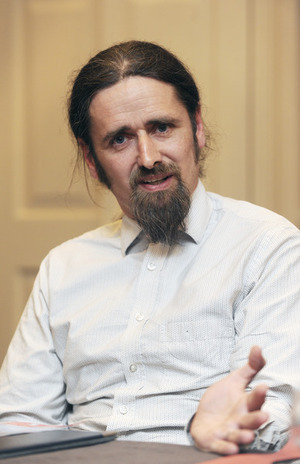
From top: The Commissioning Ceremony of new Army Officers in the Defence Forces Church, Curragh Camp, Co Kildare lin January; Luke ‘Ming Flanagan MEP

Luke ‘Ming’ Flanagan MEP writes:

In the last week, EU Defence Ministers, along with Taoiseach Leo Varadkar, met in “PESCO format” [Permanent Structured Cooperation] for the first time.

They pushed plans to strengthen European Union security and defence and cooperation between the European Union and NATO, and discussed the European Defence Fund and new laws to establish a European Defence Industrial Development Programme.

None of these PESCO initiatives are in Ireland’s interests.

The Treaty on European Union’s description of PESCO is vague, and deliberately so.

It mentions “more binding commitments”, “with a view to the most demanding missions”, to fulfil “the Union level of ambition”, but what exactly is the ambition of the European Union in the use of military force sphere?

We DO know that no matter what the propaganda coming from Fine Gael or what Taoiseach Varadkar says, ‘the most demanding missions’ have nothing to do with UN peacekeeping.

The law establishing PESCO doesn’t contain a single mention of the United Nations, nor does it refer to peacekeeping, nor even “peace”.

We know that in the Lisbon Treaty debates the European Union and the Irish Government actively suppressed discussion of the implications of the Common Security and Defence Policy, including the mutual defence clause which is an integral part of PESCO.

According to Eurobarometer surveys, carried out twice a year among EU citizens, only 12% of European citizens claim to be aware of the mutual defence clause and to know what it is.

This level of ignorance among EU citizens about the EU’s CSDP and PESCO is no accident.

Let’s look at a few facts:

1) This legally binding EU decision mandates PESCO member states to increase defence budgets, to provide troops (on stand-by) for use in EU Battle-Groups , to join “structures partaking in European external action in the military field”, and for “common funding of military CSDP operations and missions”.

2) It states quite bluntly that “Increasing joint and collaborative defence capability development projects, is among the binding commitments under PESCO”.

3) PESCO aims to establish an EU-wide arms industry, and the EU’s European Defence Agency will tell PESCO members, including Ireland, what weapons to buy.

4) International humanitarian law, also known as the laws of war, requires that all attacks be directed at military targets. Attacks cannot cause disproportionate civilian loss.

Yet, we know that in modern warfare, missiles can miss the intended targets up 90% of the time. We also know that for every one soldier killed in modern conflicts, on average, ten civilians die.

The European Union’s own European Security Strategy, adopted by the European Council in Brussels in December 2003, stated as fact that ‘since 1990, almost 4 million people have died in wars, 90% of them civilians’.

A few questions then for our Taoiseach:

1) Will the EU procure weapons including BVR or “beyond visual range” missiles?

2) Will the European Defence Agency publish the “operational pK” (probability of Kill) for the weapons it demands the PESCO member-states buy?

3) Will the Irish government support the purchase of these weapons and against whom will they be used?

4) Mindful that the US military and government pays no attention to civilian deaths in America’s wars, will the EU publish the body count of the civilians inevitably killed through the so-called “alliance of individual PESCO armies” actions in EU CSDP military missions?

The Irish political establishment tells us that PESCO is OK for Ireland to be a member of because ‘non-NATO’ Sweden is a member.

What the Irish establishment won’t say is that Swedish foreign policy is entwined with commercial arms export interests, and that the Swedish Government no longer regards itself as neutral, or even non-allied, and were active participants in the establishment of the NATO ‘no fly zone’ in Libya in 2011 because it wanted to promote sales of its fighter jets.

As Gunnar Hult of Sweden’s National Defence College said:

“(Libya) was quite beneficial to the Gripen. This is something no politician would ever admit, but it’s true. People saw it participating in air campaigns. It’s good for business.“

Ireland should have followed the path of Denmark in relation to PESCO, and secured an opt-out to PESCO and CSDP. As the PESCO law says:

“Denmark does not participate in the elaboration and the implementation of decisions and actions of the Union which have defence implications.Denmark is therefore not bound by this Decision”.

Ireland can have the same legally binding opt out.

The Taoiseach must reverse the decision he took in December 2017 to join PESCO and should instead re-orientate Irish foreign policy to neutrality and to what Ireland and her Defence Forces can do best to tackle conflicts and save civilian lives today, UN peacekeeping.

Luke Ming Flanagan is a member of the European Parliament for Midlands North West

Rollingnews

Previously: PESCO on Broadsheet

From top: Housing Minister Eoghan Murphy; Michael Taft

The Department of Public Expenditure and Reform has produced a useful analysis of spending on housing; in particular, the rent subsidy schemes.

When we put this next to the targets in Rebuilding Housing – the Government’s housing strategy – we can see how endemic subsidies to the private rental sector are. This poses challenges to policy-makers and activists in overcoming the housing crisis.

The Department report charts expenditure on private rental subsidies and capital spending on housing which actually creates additional accommodation.
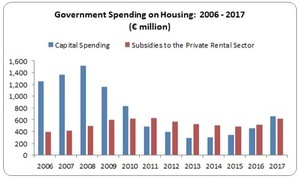
The chart shows a substantial fall in capital spending – from €1.5 billion in 2008 to €295 million in 2013, rising again to €695 million last year.

Subsidies to the private sector have also seen a rise since 2006, though slightly depressed following the crash.

In the years 2011 to 2016, private sector subsidies outstripped capital spending, though this situation was reversed last year. Between 2006 and 2017:

Capital spending totalled €9.1 billion

Private sector subsidies totalled €6.4 billion

This €6.4 billion is comprised of spending on four schemes: Housing Assistance Payment (HAP), Rent Supplement (RS), Rental Accommodation Scheme (RAS), and the Social Housing Current Expenditure Programme (SHCEP).

HAP has only been recently introduced and is intended to both replace long-term rent supplement programmes and allow recipients to work full-time. But it is already becoming a major spending item – rising from nil in 2012 to €158 million last year.

If we use a crude calculation – of dividing annual expenditure in 2016 by the number of households in receipt of subsidies – we find that the average spend per household is €5,600 with variations within the schemes.

The Department refers to the Housing Agency’s Value for Money analysis conducted in 2011. The Agency concluded that traditional social housing (local authority) fared poorly compared to the SHCEP and the RAS schemes.

In other words, the state received better value for money by effectively leasing from the private sector than by building and possessing its own housing stock.

However, this report is heavily caveated. The Housing Agency admits that the data is limited and the year that they used – 2008 – may not reflect more current trends. It called for a new study to be conducted. The Department echoed this request, claiming that times (and costs) had moved on.

Really moved on; the Housing Agency’s study used 2008 as their base year. The problem is that rents have risen dramatically, and so have state subsidies to the private sector. A couple of examples from the Department’s paper:

HAP expenditure (the Housing Agency didn’t assess HAP since it was introduced after their study) rose from €2,675 per recipient in 2015 to €3,500 the following year, a rise of nearly a third.

Rent Supplement rates increased by 16 percent in the two-year period from 2014 to 2016 in Dublin; in Cork and Kilkenny the rise was 11 and 13 percent respectively.

Any new study would have to factor this in but, further, it should also take into account not only quality but the macro-economic effect of expenditure on market-led rents (opportunity costs) and future capacity.

And capacity is a key question. Rebuilding Ireland puts a lot of store in the private rented sector’s ability to absorb an increasing number of state-subsidised tenancies.

The reliance on private sector subsidies will continue, although it will tail off somewhat as the building and acquisition programme increases.

But in this four-year period the Government expects to create 67,000 new tenancies in the private sector.

A real question is whether this is feasible – is there capacity in the private sector to provide this number?

A related – and important – question is to what extent this will squeeze supply for tenants who are not eligible for state schemes?

This reliance on the private sector is not confined to rental and leasing. State acquisitions for the social housing supply merely transfer tenure from the private to the public sector. They do not actually create additional housing. In this four-year period the state is targeting only 28,000 new builds.

Let’s face it – we have dug ourselves into a deep hole and even with the best will and policies, it will take a long time to get out. All the more reason that we should have the latest data and the most comprehensive analysis to ensure that policy achieves the optimal outcomes.

Subsidies to the private sector will be with us for a long time. Already, 15 percent of households are in state-supported housing. Therefore, it is necessary that we have the right policies to ensure quality and security for tenants, affordability for the state and no downsides for others looking for rental accommodation.

The question that needs urgent debating, buttressed by quality evidence, is whether the reliance on the currently designed subsidies to the private rented sector passes those tests.

A better route might be to escape the idea of social housing as ‘for the poor’ as distinct to a private rental sector for everyone else; especially as the private rental sector is already heavily subsidised.

We should seriously look at the Nevin Economic Research Institute’s cost-rental model which breaks down this distinction and offers up rental accommodation for all tenants regardless of income or employment status.

Ultimately, there would be no ‘public’ vs ‘private’. There would be a single rental market – providing quality accommodation at affordable rents.

That would be the best value-for-money outcome.

Michael Taft is an economic analyst and author of the political economy blog, Notes on the Front.


Muldoon’s is among three pubs in Donconrath, County Meath to close on Good Friday

In Drumconrath the publicans think
That we should have a day without drink
The new law they’ve opposed
But while the pub’s closed
Will they serve with a nod and a wink?

John Moynes

Pic: Meath Chronicle

A Lamborghini 400GT once owned by Paul McCartney – original aside from a replaced rear suspension, new gearbox and a decades-old wine red respray.

This is the 400GT 2+2 variant – or Fab Four-seater, if you will.

Yours for around €500,000.

uncrate

From top: Noel Pattern last month: Noel Pattern with John McGuirk at the Rally for Choice in Dublin on Saturday

Further to ongoing controversy regarding pro-life poster medic Noel Pattern aka Noel Patrún.

Gorugeen Fingleton writes:

So here we are a wee bit down the line and #noelthenurse and John McGuirk have started back tracking and bottom covering.

First of all though this this thread is a systematic demolition of the whole affair. @nursePollyRgn has been dogged in her pursuit of said demolition. In this thread she addresses the fake city and guilds cert in minute detail.

Mr Noel Pattern has explained that yes he did indeed amend the cert but only to make it more readable as he only has a bad copy of the certificate.

He states that he has not been able to get proper records from the UK yet but will soon.

He does acknowledge that he’s NOT a nurse. He does claim to be an operating department practitioner and further that care assistants are often referred to as nurses.

Yet you’ll see examples of him giving Medical information based on his experience as a nurse.

JSavethe8.ie and its communications director John McGuirk have acknowledged that Noel Pattern is not a nurse too.

However they hide behind the claim that it was an honest error due to their misunderstanding of medical job titles. McGuirk even posted a selfie with Noel Pattern at the anti choice parade (above).

They still maintain that Noel left the My Abortion Story campaign because he was bullied by pro choice activists.

In the previous post on Broadsheet I stated that this was either an attempted duping or incompetence. I believe the former. I wonder too will John McGuirk now change his amendment of the original Broadsheet post? I think not.

This is still being pursued and I strongly suspect there will be more updates to this sorry affair.

Last week: A Pro-Life Pattern

Broadsheet.ie