Yikes.

Previously: ‘They’re Loud And They’re Growing’

Populist Chancer Cheats Us All

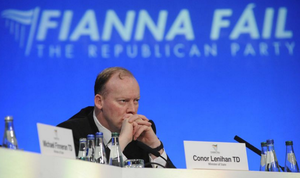
Conor Lenihan, of Fianna Fáil

This morning.

Former Fianna Fáil TD and junior minister Conor Lenihan was interviewed by Seán O’Rourke on RTÉ Radio One.

It follows a report in yesterday’s Irish Times in which it was reported Mr Lenihan is interested in running in the next European elections in 2019.

During the interview, Mr O’Rourke asked Mr Lenihan about an opinion piece written by Fintan O’Toole in today’s Irish Times in which Mr O’Toole focused on an interview in last weekend’s Sunday Business Post in which Fianna Fáil’s Barry Cowen told the newspaper the party wanted to see the Vat rate for builders and developers cut from 13% to 9%.

Mr Cowen told the Sunday Business Post:

“We’re looking at a Vat holiday for a sunset period for the construction sector. We are calling for a reduction in development charges and planning levies. The pussy footing is over. There has to be radical measures for a period to allow the sector get back on its feet. To allow the sector to create affordable homes, to allow local authorities to be given the space to build houses.”

Mr O’Toole wrote:

The party [Fianna Fáil] has a bad case of builder’s bum: when it bends over to help out its friends it reveals the hideous gap between its recent left-wing rhetoric and its true loyalties.

If tax breaks for developers created a stable housing market and good urban planning we’d be living on Paradise Island.

Developer-led get-rich-quick schemes, fuelled by tax incentives, have led only to disaster.

Further to this, Mr Lenihan and Mr O’Rourke had the following exchange.

Conor Lenihan: “I think there’s a very serious crisis here and the current government and the previous government have done very little in this area. We do need emergency measures, we need something that actually gets builders and the constructions sector building houses.

“This is not rocket science. We do need to provide incentives to people who are building houses to go out and build them. And if you talk to builders and plenty of us do, it’s very clear that the mixture of taxation on a house, to build a house, makes it very disadvantageous for people to get into building houses.

“So this is a very serious thing that has to be addressed. Now it’s nothing to do with anybody’s relationship with the building industry but I would point out that, notwithstanding the brickbat thrown by the likes of Fintan O’Toole against Fianna Fail in relation to our relationship or whatever, with the building industry that it’s very clear from the data, from 1922 on, from the period after independence, that the amount of social houses built by Fianna Fáil governments, is very consistent. We’ve always built more social housing than any other party in this State. So the record…”

O’Rourke: “Coming back…”

Lenihan: “…is good in terms of one level if you look at the actual data…”

O’Rourke: “Well, I think you’d probably have to go back to the 1950s to find your real achievements…”

Lenihan: “No, the social housing schemes were started in the 1930s by the De Valera government and a time when the previous government had no interest….”

O’Rourke: “In the Ahern era, and thereafter, it became a question of just leave it to the markets.”

Lenihan: “Yeah, and I think that was a mistake by all parties in Leinster House. We need to have social housing…”

O’Rourke: “No, hang on, you were the guys in Government from 1997 for the next, what was it, 14 years?”

Lenihan: “That’s right. Yes, but there was a, but there was a consensus in the Dail. The Opposition parties were asking for more, more tax cuts, more spending…”

O’Rourke: “Ok, just to come back to where we started…and your potential return to the political fray here, your name being on the ballot paper. Have you spoken to Micheal Martin about this idea?”

Lenihan: “Of course I have, I’ve spoken to him and I made it clear that I was open and available.”

O’Rourke: “And what did he say?”

Lenihan: “Well he was very encouraging, of course. As party leader, he does not and cannot express a preference for one candidate over another. He has to be respectful to the membership but I was glad to be able to meet him and share my ambition in that regard.”

Listen back in full here

Meanwhile…

Speaking of ‘sunsets’….

From an academic paper, published in the Irish Political Studies journal in 2011, about the Irish financial crash.

The paper was called Financial and Economic Crisis: Explaining the Sunset over the Celtic Tiger, and was written by Raj Chari, of Trinity College Dublin and Patrick Bernhagen, of the University of Aberdeen in Scotland.

Also.

Any excuse

An experimental art film by Maxim Zhestkov featuring the movement of over two billion black and white spheres in a series of enclosed spaces.

The physics of each animation (flow, diffusion, pressure, etc.) is displayed by subtle text on the walls of each space. Zhestkov sez:

The film is a trial to explore the idea that everything around us and inside us is made from simple elements or blocks which can be arranged in complex relationships and become compound structures. We could project this idea into emotions, behaviors, thought processes, relationships, life, planets and the universe.

Now for yiz.

colossal

Amy Fitzgibbon writes:

I thought you might be interested in featuring this tweet (above) on your website. It has been entered as part of a competition EirGrid is running in association with the GAA where clubs can be in with a chance of winning a brand new digital clock and scoreboard by submitting an image that represents their favourite GAA Moment in Time. Full details here.
We just thought the tweet was a really good example of Irish humour and the volunteering spirit of the GAA.

Modular housing in Ballymun, Dublin being built in April

This morning.

Further to the Irish Fiscal Advisory Council releasing a “buoyant” pre-Budget statement…

On RTÉ’s Morning Ireland.

Seamus Coffey, chairperson of the Irish Fiscal Advisory Council (IFAC) and UCC economics lecturer, spoke to Audrey Carville.

Audrey Carville: “I suppose for many people the question is this: is it possible for the Government to stick to existing plans and still do more to tackle the housing crisis?”

Seamus Cofffey: “Oh absolutely, I think a key point that we’d make is that choices have to be made. That if there are priorities that we wish to address, these are the ones where the available resources are targeted. And if we look at capital spending in which the provision of social housing would be one element over the next couple of years, capital spending, Exchequer capital spending  is set to  double from the level it was in 2016. It’ll be almost double that by 2021.

“So the Government has set out a plan that does see quite a rapid and large increase in capital spending and this plan is in line with the fiscal rules. In fact, if you take the plan to 2021, it’s probably showing over-compliance with the fiscal rules. Yet within that, they are finding the space to double capital spending.

“Yes, we have some severe and serious problems at the moment. They take a long time to build up and equally they can take a while to solve but there is the space to do that, if things are prioritised.”

Carville: “What will happen though if the Government says, ‘well no, actually, we’re facing an emergency of such a nature that more has to go into the provision of public housing straight away, that we have to change things slightly. ”

Coffey: “Well, again, it’ll be choices, if you want to provide more for social housing, you can transfer spending resources from elsewhere or you can  raise additional funds from tax revenue.

“One issue we’d be concerned with is the overall impact, the fiscal and the government sector has on the economy. We’ve an economy that’s growing very, very strongly at the moment and has been for a number of years. The unemployment rate has dropped down to 6%. If we feel we need to ramp up say, output in housing, both say in the private sector and in the public sector, one issue is: do we have the resource capacity to do that?”

“Where are the workers going to come from? Are the workers going to come from other sectors in the economy? Maybe driving up wage rates? We’re beginning to see, although moderate at present, wages beginning to rise. Are we going to import workers from abroad? And, of course, if we bring in the workers to build the houses, that’s only adding to the problem we’re trying to solve with greater housing supply in the first place.”

Carville: “There is also the question of where those workers might live at the moment, because of the severity of the crisis. There have been all sorts of calls for different measures. For instance, over the past couple of days, we’ve heard Fianna Fail saying that there should be tax cuts for developers to encourage them to develop houses more quickly. What do you think of that idea?”

Coffey: “When it comes to individual measures, the fiscal council sort of remains outside the debate. What we’re looking at is the overall impact of all the decisions taken by Government and that’s not just on the spending side. There does seem to be a kind of impetus on the sort of spending watchdog. You can also have issues on the revenue and tax side as well. It’s a combination of those decisions. When it comes to actual individual measures, that’s a matter for the political process to decide. We consider what the outcome is in terms of the overall Government account and the impact on the economy.”

Carville: “So you don’t have an opinion one way or another, or at least one that you’re going to give us on the question of tax cuts for developers?”

Coffey: “Correct.”

Listen back in full here

Meanwhile…

Last night…

The Irish Independent reported:

Housing Minister Eoghan Murphy angered members of Dublin City Council (DCC) after he decided against appearing before the council to discuss the housing crisis.

The council had sent an invitation to the minister, asking him to attend its first meeting after the summer break, which took place tonight [Monday night].

However, Lord Mayor of Dublin, Michael McDonacha, revealed Mr Murphy responded that he would appear only after the Rebuilding Ireland report had been completed.

Anger as Housing Minister Eoghan Murphy fails to attend council meeting to discuss the housing crisis (Irish Independent)

Previously: ‘Will They Still Be Your Friend? Or Will They Find You Scum?’

Broadsheet.ie