
3xenerly800nogrid

Isn’t it well for you?

3Xe Digital, the Mobile marketing conference kicks off tomorrow in Croke Park.

Guest speakers include Ed Melvin, Digital Strategy Director of Publicis, Dublin (they dreamt up the Murphy’s pint when it shines app) Tom Farrell, Senior Director of Marketing at Swrve, and Ronan O’Hallaron, Practice Director, Storm Technology.

We have two, YES TWO, tickets (worth €295) to give to mobile loving marketeering Muskateer.

To enter complete this sentence.

“My first EVER mobile phone call was to_____________________on a_________________’

Lines MUST close at 9pm 10pm.

Winner will be emailed tonight.

Update:

Winner

Serveandreturn: My first EVER mobile phone call was to set up my voicemail. My SECOND ever mobile phone call was to the same phone on the same day (it was a deal the AIB were doing in UCD). This story is a vehicle to tell everyone my mother and I started the same Orts degree in UCD at the same time, which is a strange little factoid. It is also a good example of bad communication, as I haven’t delivered an on-point answer via digital communication. Now if there was only some course I could go on to rectify this…

Thanks all

3xedigital. com.

Palace-of-Mystery-Quinta-da-Regaleira-by-Taylor-Moore7__880 Palace-of-Mystery-Quinta-da-Regaleira-by-Taylor-Moore8__880 Palace-of-Mystery-Quinta-da-Regaleira-by-Taylor-Moore19__880 Palace-of-Mystery-Quinta-da-Regaleira-by-Taylor-Moore23__880 Palace-of-Mystery-Quinta-da-Regaleira-by-Taylor-Moore31__880 Palace-of-Mystery-Quinta-da-Regaleira-by-Taylor-Moore38__880Palace-of-Mystery-Quinta-da-Regaleira-by-Taylor-Moore34__880 Palace-of-Mystery-Quinta-da-Regaleira-by-Taylor-Moore35__880 Palace-of-Mystery-Quinta-da-Regaleira-by-Taylor-Moore39__880 Palace-of-Mystery-Quinta-da-Regaleira-by-Taylor-Moore43__880
Pictures by Taylor Moore of the bewildering and spectacularly bonkers Quinta da Regaleira in Grand Lisboa, Portugal, located near the UNESCO World Heritage town of Sintra (and included within its designated ‘cultural landscape’).

The estate was developed between 1904 and 1910 by Portuguese entomologist Carvalho Monteiro, who commissioned Italian architect Luigi Manini to construct a series of enigmatic buildings combining the gargoyles, steeples, chapels and towers of Gothic, Renaissance, Roman and Manueline styles with symbolism relating to Masonry, alchemy, the Knights Templar and the Rosicrucians, not to mention fantasy grottoes, caves and a deep dry well ringed with a spiral staicase.

Currently owned by the Sintra Town Hall, it was opened to the public in 1998.

More pix here.

boredpanda

76131024_1982_kincora_boys_home

Kincora Boys’ Home, East Belfast.


A deadline of January 31 has been set for the British government to furnish all documents on Kincora Boys’ Home to the Northern Ireland Historical Institutional Abuse Inquiry.

It is alleged that children at the home were raped and abused by a paedophile ring operating at the home with the knowledge of security forces.

Henry McDonald writes:

It will be fascinating to find out if, for instance, the Kincora material includes any “smoking gun” documents; ones which prove what many have suspected for decades – that the State knew about the paedophile ring there but did nothing to protect the boys from their tormentors. Instead, of course, the security forces resorted to blackmailing the abusers in order that they spy on fellow hardline loyalists.

…Even in situations where local political figures were compromised as a result of their sexual preferences, successive Governments ensured that these people were protected from public exposure in the wider interests of stability, political progress and even the peace process itself.

This writer knows of two cases in the late-1980s and 1990s in which two politicians were about be exposed by the tabloid Press, but the State then intervened to save their reputations.

Conspiracy of silence that shields Tory Kincora paedophile a symptom of State’s sordid double deals (Henry McDonald, Belfast Telegraph)

Previously: A Boys’ Home Story

(BBC)

cryingchair Private-Residential-Tenancies-Board

No point just sitting there crying.

Further to much concern among readers who rent.

With zero control, zooming prices and broken crying chairs littering Daft is there anything tenants can do if a landlord notifies them that their rent is being increased?

We asked Legal Coffee Drinker what’s it all about.

Broadsheet:  “Legal Coffee Drinker, what’s it all about?”

Legal Coffee Drinker: “It’s about landlords trying to get as much as they can out of tenants in an apparently rising rental market.”

Broadsheet: “Is this even legal?”

Legal Coffee: “Part III of the Residential Tenancies Act 2004 provides that a review of the rent under the tenancy may be effected by either party. Section 22 of the Act states that where the landlord reviews the rent, he must serve a notice in writing on the tenant stating the amount of the new rent and the date from which it is to have effect. If the tenant doesn’t challenge the reviewed rent, it takes effect 28 days from the date of the notice or the date on which it is stated to have effect, whichever is the latest.”:

Broadsheet:  “The tenant doesn’t have to accept the reviewed rent?”

LCD: “Absolutely not.  All residential tenants have the right to challenge a reviewed rent by making an application to the Private Residential Tenancies Board (‘the PRTB’) to have the Board determine whether it is really market rent. The tenant has 28 days from the date of receipt of the notice of rent review to make that application, which should be made by registering with the PRTB as a tenant [link below], submitting the Dispute Resolution Form available and paying the necessary fee of €15-25 (€15 Euros for online application; €25 for paper application).”

Broadsheet:  “And what happens then?”

LCD: “Well, once a dispute resolution form has been submitted, the dispute resolution in Part 6 of the 2004 Act comes into force. The parties are given a choice between having the correctness of the rent determined by mediation or arbitration.  Mediation involves both parties trying to agree the rent; arbitration involves an individual nominated by the PRTB listening to both sides and coming to a decision.  If either party is unhappy with the decision of the arbitrator, or if no agreement can be reached on mediation, the matter may be appealed/referred to a three-person body known as the Tenancy Tribunal, which will make the final decision. ”

Broadsheet: “And what sort of view is the Tenancy Tribunal taking on market rent?”

LCD:  “Difficult to say, as there have been very few applications challenging rent increases to date.  The Tenancy Tribunal will only approve a reviewed rent which is equal to or less than the rent the landlord would get for the premises on the open market.  Ideally each side should have examples of rents charged in respect of similar premises, which have been recently let in the area.”

Broadsheet: “So if all the landlord is looking for in the increase is the rent that he would genuinely get the premises for in the open market, there’s no point in challenging the review.”

LCD:  “Agreed.  If the increased rent is indeed the open market rent, the PRTB must uphold it.   But it’s up to the landlord to prove this.  And the PRTB generally is not unsympathetic to tenants, where there is room for doubt.

Also, the 2004 Act provides that the rent may not be reviewed at all during the first year of a lease or more often than once a year.  Rent reviews breaching these timelines can be struck down by the PRTB even if at market rent.”

Broadsheet: “Do you need a lawyer to take proceedings before the PRTB?”

LCD: “No. In fact the PRTB encourages parties to represent themselves or be represented by a friend.  It’s just a question of turning up and having your say. Threshold often provides volunteer advocates for tenants on request.”

Broadsheet: “Is there a risk that it will end up costing you money? ”

LCD:  [drains coffee] “Only the dispute resolution fee, your time spent, and the expense of any witnesses you bring along.   Although in theory the PRTB can make costs orders against parties, this is rarely exercised against the tenant – except maybe in cases where they fail to turn up for the hearing without excuse. ”

Broadsheet: “As it would demonstrate tardiness.”

LCD: “Right.”

Broadsheet: ” If you can’t even be bothered to show up for the hearing. Anarchy!”

LCD: “Are we done?”

Broadsheet: “We are. Thank you Legal Coffee Drinker. Hopefully you’ll be our  ‘friend’ at a future board hearing  if Karl’s mum starts charging us to use the den.

LCD: *click*

Private Residential Tenancies Board

Inventers-Fair-750x489 Traffic-Zoom-750x488Traffic-750x489 Zoo-Zoom13_54_Wimmel_1_1904-1066x1600750Zoo-750x489 WebsiteJans beautiful world where everything can happenInventers-Fair-Zoom-750x48813_54_Wimmel_1_1974

Konrad Wimmel Is In Town! – a joyful composite photoseries by German photographer  Jan Von Holleben who shoots his subjects from above as they pose sideways on the floor of his studio. I

It’s a technique that’s been well explored by the likes of Matej Pelijhan and others but Holleben – some of whose images feature up to 5000 individual photographs – takes it to a whole new L.S Lowry-esque level.

petapixel

Screen Shot 2015-01-28 at 13.17.34

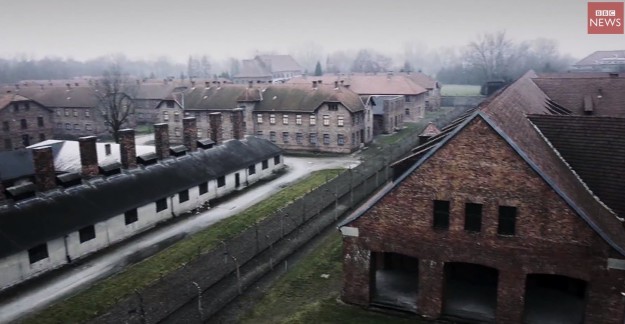
Extraordinarily haunting drone footage of Auschwitz-Birkenau by BBC News. To wit:

Drone video shows the Auschwitz-Birkenau concentration camp as it is today – 70 years after it was liberated by Soviet troops. The camp in Poland is now maintained as a World Heritage Site and is visited by thousands of tourists and survivors every year. Auschwitz was the largest camp established by the Germans during World War II. More than a million people – the vast majority of them Jews – died there between 1940, when it was built, and 1945, when it was liberated by the Soviet army.

Railway tracks into Auschwitz-Birkenau – Trains filled with victims from throughout occupied Europe arrived at the camp almost every day between 1942 and the summer of 1944.

Ruins of wooden huts at Birkenau – Birkenau (or Auschwitz II) was erected in 1941 solely as a death camp, the wooden huts are now in ruins with only brick fireplaces and chimneys remaining.

Entrance to Auschwitz I -The wrought-iron sign over the entrance bears the words Arbeit Macht Frei – “Work sets you free”. The brick-built buildings were the former cavalry barracks of the Polish Army.

Courtyard between blocks 10 and 11 at Auschwitz I – Block 11 was called “the Block of Death” by prisoners. Executions took place between Block 10 and Block 11 and posts in the yard were used to string up prisoners by their wrists.

fullist/BBCNews

(H/T: Kevin Whitty)

Broadsheet.ie