



Yearly Archives: 2016

Children’s Minister Katherine Zappone at a homeless event this morning
Then.
The Bill does not legislate for termination in cases of fatal foetal abnormalities. The Government has argued that it is only obliged to deal with the issues that relate to the European Convention, the implementing of the A, B and C judgment and the X case and that it is not obligated to go any further.
Obligated by whom or what? Why is this an issue for another day? It may be for another day in light of political strategy and tactics. I do not agree that it is for another day in light of ethical considerations and international human rights obligations.
Then Senator Katherine Zappone, during the seanad debate on the Protection of Life During Pregnancy Bill, 2013.
Now.
Children’s Minister Katherine Zappone says she wishes her fellow Independent Ministers hadn’t insisted on a free vote on abortion.
Mick Wallace’s bill has caused a rift in Cabinet, with Independent Ministers including Shane Ross and Finian McGrath, due to vote against the rest of the government later when they support the “fatal foetal abnormalities” bill.
Minister Zappone, regrets that her fellow Independent Cabinet Ministers have refused to side with the Government on abortion.Zappone Wishes Fellow Independents Hadn’t Insisted On A Free Vote (Clare Fm)
There you go.
Previously: Unconstitutional Deference
Rollingnews

ELLLL – new EP due soon on Art for Blind
What you may need to know…
01. Ellen King, aka ELLLL, specialises in a brooding, minimal, dark techno.
02. Emerging quietly from Cork’s noise and sound art scene, ELLLL’s work has taken a beatsier turn in recent years. A founder member of the GASH Collective, a platform for women in Irish electronica, she’s pictured above in the middle of her recent set for Boiler Room in Dublin, having also recently featured at Life and Open Ear festivals.
03. Streaming above is the video for recent single ROMANCE. Video compiled and edited by Louise Adelaide McKeown.
04. King’s debut EP is due for physical release by the end of the summer on Cork/Sligo/Leeds label Art for Blind Records. Catch her next at Bastardo Electrico’s next night at Cyprus Avenue in Cork, sharing a bill with Berlin electronic collective Killekill.
Verdict: A quiet but assured presence in Irish electronic music. Propulsive without sacrificing atmosphere or minimalism, the upcoming extended-play ought to be a treat.


From top: Shot heifer at John Hoey’s fam in Co Monaghan Chris Lehane, a court-appointed trustee who takes control of the assets of bankrupts; interview with Mr Hoey on Cork’s 96fm Opinion Line
Further to revelations yesterday that five heifers were shot by members of the armed forces on Tuesday as part of a debt recovery exercise.
The owner of the stock – farmer John Hoey from south Monaghan – told the Irish Farmers Journal that the army was called to shoot the animals after the debt collection service had struggled to load the five animals on to a truck.
The owners also allege that all other machinery from the farm had been removed. It is understood that the local Department of Agriculture vet had been made aware of the military exercise.
The Irish Farmers Journal understands that a long-standing protocol between the Department, An Garda Síochána and the army allows for intervention when there is a threat to public safety.
A fallen animal service was called to collect the dead animals but subsequently got stuck in the field they were in.
The Official Assignee in Bankruptcy, Chris Lehane, said in a statement that he had made the decision to have the cattle killed after failing to remove all the “wild and dangerous” animals from the farm with “experienced cattle assistants”.
“As Official Assignee I have a duty to recover value from assets of bankruptcy estates and it is clearly not in my interests to kill cattle, nor would I do it, without firstly having exhausted every other possible avenue open to me to resolve the problem.”
The Official Assignee in Bankruptcy is part of the Insolvency Service of Ireland, the independent statutory body tasked with monitoring situations in which people are unable to pay their debts.
Yesterday: Animals
Meanwhile, Seaán O’Rourke spoke to both John Hoey and his partner Aisling McCardle this morning.
From the discussion with Aisling…
Seán O’Rourke: “What would you say to the point made by Chris Lehane, the Official Assignee, that he has a duty to recover the value of assets in bankruptcy estates and it’s clearly not in his interest to kill the cattle, nor would he do it without firstly exhausted every possible other avenue open to him to resolve the problem?”
Aisling McCardle: “He is very incorrect in what he’s saying because he didn’t exhaust every avenue. He never, in all his time, that we spoke to the Official Assignee he never said, ‘we’re coming to shoot the cattle because we can’t capture them, will you go out and take the cattle in’. Like, as Johnny has explained, if he goes out with a bucket of meal, he’d have those animals in, in ten minutes. So he didn’t exhaust every avenue, he wasn’t taking health and safety affairs into consideration for us because we were out in the middle of this the other morning. I mean, some of us could have got shot very easily and where would the health and safety have been then? He did not exhaust every avenue.”
O’Rourke: “Well I suppose they would have been very careful about it, you’re talking about professional marksmen here now. Professional markspeople. They’re very careful where they shoot now, wouldn’t they?”
McCardle: “Yeah, but they still didn’t shoot the animals appropriately. Like some, as I was walking back up the road after that animal had been shot down there, there was the three animals that had shot up there in the corner, they were heading back… The armed men was coming back over, through the meadow, to get into a van, to be taken away. They actually stood over the three animals that were on the ground, lying there ready and shot them two or three times more.”
Listen back here

Here’s a bit of the video. This is ridiculous. pic.twitter.com/NqEAf8aRMd
— Eoin Ó’Faogáin (@Eoin_OF) July 6, 2016
Last night.
Eoin Ó’Faogáin writes:
If you ever wondered why in the north inner-city people feel wary of the Gardai and how they behave, here’s an example.
Last night I was coming back from playing five-a-side with two friends. Car gets pulled over. Garda says can you pull in and leave the vehicle. Mate says ‘what for?’ Garda says ‘where are you going?’
Mate (above) says ‘on the way back from football and I’m going home to Sheriff Street. Why are you asking me to pull over?’ Guard says just get out please. Mate points out his constitutional rights.
Next thing two more gardai appear and tell him he’s being arrested. Mate asked, then I asked, ‘WHAT FOR?’ They refused to answer. Cuffed him, left his car in the middle of the road and then the gardai who were left with the car laughed about how they’d have to get a tow truck and bring it to Donabate “for a laugh”. Here’s a bit of it I got on video here.
We kept asking what he was being arrested for and garda who was left there says “why are you asking me, I haven’t “a clue.”.
Last two gardai got in their car with our mate’s car still in middle of road and shouted out “enjoy your walk home boys”. WTF?
Previously: We Need To Talk About The Guards
https://vimeo.com/170779599
A gig’s a gig.
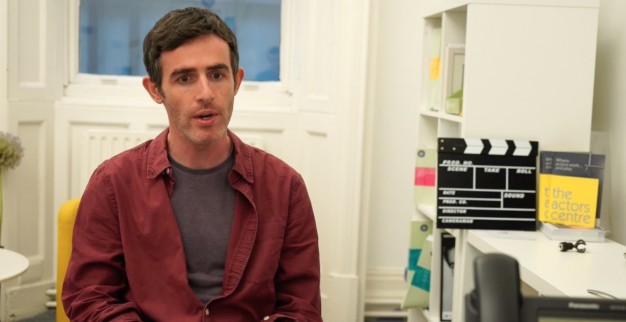
Written and edited by Aidan Lawlor, featuring Aidan Lawlor, Conor Dowling, and John Anthony Smyth.
(Thanks Aidan)

Actor Bryan Murray supporting collective bargaining rights for freelance workers, outside Leinster House, Kildare Street, Dublin 2 yesterday
In Carrigstown and in Red Rock
The actors are paid by the clock
But if you leave Fair City
For something more gritty
Your wallet is in for a shock.
John Moynes
Rollingnews

From top: turf cutting in Connemara, 1960s by John Hinde; Dan Boyle
By 1995, 99% of Irish raised bogs had disappeared.
In the period since, more than one third of the remaining one per cent has been lost.
Dan Boyle writes:
A lost family photograph of ours evokes a particular memory for me. I was about four years of age standing next to my grandfather, who was standing next to his donkey, which had baskets on either side full of turf.
It looked for all the world like a John Hinde postcard depicting an over romanticised view of Ireland, which if it ever existed certainly doesn’t exist now. My grandfather would have cut turf by hand. That Ireland is certainly dead and gone.
Or at least it should be.
Raised bogs are only small proportion of the bogs that exist in Ireland, those chosen for protection a smaller number again.
Bearing in mind that it takes ten thousand years to create a bog, it is harrowing to learn that by 1995, 99% of Irish raised bogs had disappeared. In the period since, more than one third of the remaining one per cent has been lost.
It has been almost 30 years since an EU initiative on conservation has taken root in Ireland. The EU Habitats Directive was first proposed in 1988 being fully adopted in 1992.
In Ireland it wouldn’t be incorporated into Irish law until 1997 under legislation moved by now President, then Minister for Arts, Culture and the Gaeltacht, Michael D. Higgins. This delay was followed by further delays in implementation.
Rural pressure groups argued that the Habitats Directive was being applied too stringently. Successive governments reacted to this pressure by stalling on implementing the legislation.
Slowly, too slowly, Special Areas of Conservation (SACs) began to be defined. However in typical indecisive Irish government action, derogations have been applied to many of these SACs since 1997.
Raised bogs are but a small component of the SACs that have been selected. Together their area is about 10,000 hectares. This represents about 5% of the turf available for cutting. Other raised bogs have been given less stringent Natural Heritage Area (NHA) status.
A campaign centred around the ‘right’ of not applying the Habitats Directive to raised bogs gathered momentum.
Based on the precept that what always has been done should always be done, and the underlying unstated theme that everything that happens in rural Ireland is intrinsically right, the campaign demonised everyone who denied the right to continue to cut turf on raised bogs – The EU Commission, several Ministers for the Environment and later for Heritage, and more viciously officers of the National Parks and Wildlife Service (NPWS).
The ugliness of the illegal turf cutting campaign is most particularly felt by NPWS officers, a small group of people who have had inadequate State support.
While some of the raised bogs are owned by those who are protesting against the SAC designation most bogs are on already publicly owned land where the turf cutters have had turbury rights – the right to cut turf on public land. A right extinguished once conservation is introduced.
In 2010 as then Minister for the Environment, John Gormley ended the derogation on many of the raised bog sites, alongside a phased timetable for ending all derogations.
As a Green Minister for the Environment he was already being demonised by the turf-cutting lobby. Ultimately this action has not been successful as the compensating factors – financial and relocation have been rebuffed by the turf cutting lobby.
The issue has been used skilfully and successfully by Luke ‘Ming’ Flanagan, and his successor Michael Fitzmaurice, to bring about their election to Dáil Éireann.
The name of the lobby promoting this campaign – The Turf Cutters and Contractors Association – seems to be the most honest thing about them.
Supporting illegal turf cutting in micro terms causes environmental risks in the form of compromised drainage, and at a macro level removes the potential of untouched raised bogs operating as important carbon sinks, such support is incompatible with being an environmentalist.
Big Brother happens to be the good guy in this case. It is about heritage not greed.
What’s most surprising is the most reasoned sentiments on the issue that has been already been far too prolonged, have been made by the European Commission.
This is an issue where the cliché of ‘stop digging’ has a literal meaning.
Dan Boyle is a former Green Party TD and Senator. Follow Dan on Twitter: @sendboyle
America
at
Clean sweep at Rydalmere st pic.twitter.com/0KjaSiWc9W
— Hugh Russell (@russellhugh1) July 6, 2016
Colm Dore writes:
This pic is like a work of art – only in Belfast – worthy of Mark Cousins