Almond milk requires almonds, which grow on trees with flowers, which require bees to pollinate them

If you’re trying to live dairy-free
But can’t think what to put in your tea
You could try almond milk
Or something of its ilk
But don’t say you’re a friend of the bee

John Moynes

Pic: Olive magazine

Last night.

Free the lanes!

From top: members of The Black and Tans ; Minister for Justice Charlie Flanagan, right, and Taoiseach Leo Varadkar, centre, with Minster for Business, Enterprise, and Innovation Heather Humphreys, left, and Minister for Rural and Community Affairs Michael Ring (second from right) at a Fine Gael ‘think-in’ last September; a tweet from the taoiseach this morning.

This evening.

Minister for Justice Charlie Flanagan has released the following statement:

“As a Government, we have at all times sought to have a national programme of commemorations that is authentic, sensitive and inclusive.

“We very much support the recommendation that there should be specific State-led initiatives to commemorate the Royal Irish Constabulary (RIC) and the Dublin Metropolitan Police (DMP).

“However, given the disappointing response of some to the planned event on 17th January, I do not believe that the event, as planned, can now take place in an atmosphere that meets the goals and guiding principles of the overall commemorative programme.

“Therefore, I am announcing its deferral.”

“I know that, regrettably, this decision will be a cause of hurt and upset to many people. I commit to proceeding with an alternative commemoration in the months ahead.

“As a next step, I will consult further with the expert Advisory Group on Centenary Commemoration, with the all-party consultative group on commemoration and with other stakeholders, with a view to organising an event that is inclusive and fully respectful of all the traditions and memories on this island.”

Govt defers RIC commemoration event (RTÉ)

EARLIER:

EARLIER:

EARLIER:

Fianna Fáil leader Micheál Martin released the following statement in respect of the controversial ceremony to commemorate the Royal Irish Constabulary and Dublin Metropolitan Police on January 17 in Dublin Castle…

“Over the last twenty years a model of inclusive commemoration has been developed and implemented by successive governments. Central to this has been the role of public consultation and expert advice.

“The government has caused an unnecessary controversy around this RIC/DMP event by abandoning this approach.

“Recommendations on the commemoration of the War of Independence and Civil War were submitted to government by an all-party and expert group two years following a widespread public consultation.

“These recommendations were accepted by government. While these recommendations included the sensible view that the role of the RIC should be remembered in some way, there was no discussion involving the most appropriate method of doing so.

“An all-inclusive event, remembering all who died during the War of Independence is already scheduled and it was understood by all involved that this would be an appropriate moment to demonstrate that we also remember those who did not support the struggle for national independence which was secured by the men and women who are the focus of many other events.

“It is important to explore every element of this period and use this time as an opportunity to properly discuss every aspect of a complex history.

“It is also undeniably true that many decent people joined the police force of the day for legitimate reasons but found themselves on the wrong side of history. Indeed, elements of the RIC worked closely with those fighting for Irish freedom at great personal risk.

“I am acutely conscious also of how this controversy, and some of the language being used in the debate surrounding it, will be received by different traditions in Northern Ireland.

“We need to have a calm and mature discussion. In my view, the event organised by the Justice Minister is not the appropriate vehicle to explore such complex themes.

“It was an error of judgement compounded by the Taoiseach and the Tánaiste and their reaction to those who have decided not to participate.

“They should withdraw their accusation that, to quote Minister Flanagan, those who choose not to attend this event are abandoning “mutual understanding and reconciliation”.

“The years ahead will have many anniversaries that will pose difficulties and confront us with challenging questions about the country’s journey to independence.

“It is critically important that we come through this process in a spirit of honesty and reconciliation.

“We need to rediscover the generosity that informed the 1916 commemorations and return to the open engagement and consultation of that process.

“This event will go ahead, and those who wish to participate in it should be fully respected in doing so.

“However, I also believe that the special cross-party committee on commemorations should be reconvened to consult on future commemorations and that it be asked to look again at the question of how we appropriately appraise and remember the activities of the RIC and the DMP over the course of the coming years.”

EARLIER:

From top: Dublin City Council Fine Gael councillor Anne Feeney; How Dublin City Councillors voted last night on the motion to boycott the RIC commemoration service;

This morning.

On RTÉ’s Today with Seán O’Rourke, presented by Cormac Ó hEadhra.

Fine Gael councillor on Dublin City Council Anne Feeney spoke to Mr Ó hEadhra about last night’s vote by the council to boycott the national commemoration service for the Royal Irish Constabulary.

The motion to boycott the event was passed by 38 votes to ten.

Ms Feeney was one of the ten councillors to vote against it.

This morning, shetold Mr Ó hEadhra:

“Firstly, what I want to say, I want to acknowledge the great job that state and the country and Government, and all parties involved, did, in relation to the commemoration of the 1916 patriots and events.

“We did that with great respect and with great dignity.

“And I think people generally felt part of that. And many of us remember the relatives who fought and sacrificed in relation to that.

“We’re now heading into much trickier water with the forthcoming commemorations around the War of Independence, the Civil War and various others.

“And I’m not sure we’re ready for this.

“My personal view is that we maybe should reconsider these commemorations in terms of what we’re trying to achieve. And are we just opening up division and derision which I’d hoped we were leaving behind in relation to how Irish we are.”

Asked if she’ll stay away from the commemoration or if she’ll attend, she said:

“Well I wasn’t invited, so that hasn’t arisen at this point. But, you know, I prefer to look forward and I prefer to…”

When she was asked if she thinks it’s a “good thing to commemorate the RIC”, she said:

“It depends on the commemoration really. And it depends on the appetite for it in the country. You know, I think we have to listen to people, we have to listen to the public and certainly there were very decent people in the RIC as well as rogues.

“And, you know, I think, for a family of deceased members of these, some form of commemoration that would be apt for them, at least appropriate. But I think we need to take, you know, take on board the temperature and listen to people.

“A lot of people feel it’s not appropriate at this point.”

It was put to Ms Feeney that Taoiseach Leo Varadkar, who supports the initiative, suggested that councillors or mayors who do not wish to attend should “at least allow someone in their stead”.

Ms Feeney said:

“Well I think they should allow them go. But I think, you know, it’s up to individuals to make up their own mind in relation to it.

“And what Minister Charlie Flanagan has stated is, is that this commemoration is to commemorate the role of Irish men in the RIC police force in Ireland, not the black and tans, not the rogue ones, not the dysfunctional ones.

“Now that’s the official line on that but we just need, we all need to be sensitive and respectful of each other as we go forward.

“I think as a nation, we should have matured that much.”

Listen back in full here

Earlier: “Obscene”

Pic of votes: Claire Dunne

Fianna Fáil leader Micheál Martin

This evening.

Fianna Fáil leader Micheál Martin spoke to Mary Wilson on RTÉ’s Drivetime ahead of a meeting he is expected to hold with Taoiseach Leo Varadkar on Thursday.

They discussed the confidence and supply agreement that his party shares with Fine Gael and which underpins the Government.

They had this exchange…

Mary Wilson: “If there’s a vote of no confidence put down in the Minister for Health, what will Fianna Fáil do?”

Micheál Martin: “Well, if there’s an agreement to Easter, in our view, there will be no need for such motions of confidence or no confidence.”

Wilson: “But if there is one?”

Martin: “If there’s an agreement, we’ll stand by the agreement…”

Wilson: “So you’ll abstain?”

Martin: “…as we have…”

Wilson: “You’ll abstain?”

Martin: “As we have with all other agreements.”

Wilson: “You’ll abstain?”

Martin: “But I think we’ll have to be in agreement in advance, in my view. Otherwise, everybody is vulnerable to the opportunism that such motions represent. We had one before Christmas, Mary. Everybody knew it was a pre-Christmas stunt. No-one wanted an election on the 28th of December. I’m talking about the motion of no confidence in [Housing Minister] Eoghan Murphy. So I’m not really, I’ve no interest in that type of political stunt-making.

“But what I am interested in is the way to avoid all of that is to have a sensible agreement and others then might follow – Independents and other smaller parties might say ‘you know, that’s reasonable, let’s get four or five important pieces of legislation through…”

Listen back in full here

EARLIER:

Fiach Kelly, in The Irish Times, reports:

Fianna Fáil leader Micheál Martin has said there is “no question” of his party voting for the Government as requested by Taoiseach Leo Varadkar.

Mr Varadkar has asked Mr Martin to support the Government in some Dáil votes if he wants to secure an election date.

Mr Martin told Newstalk he will not change his approach, setting up a confrontation between the pair at a meeting on Thursday night to discuss the election date and the end of the confidence and supply deal.

The meeting will take place in Dublin although the time and venue have not yet been confirmed.

Micheál Martin says ‘no question’ of his party voting for Government (The Irish Times)

Micheál Martin says ‘no question’ of his party voting for Government (Newstalk)

Listen to the Newstalk interview in full here

Cork University Hospital

This afternoon.

Dr Liam Healy, a consultant geriatrician at Cork University Hospital with special interest in stroke, recalled on Twitter an incident over the Christmas period in which a mum of two, aged 35, suffered a stroke.

Dr Healy tweeted:

“Mammy’s not well”

Five-year-old Priya has FaceTimed her Dad, Damian, using the family iPad. Damian is on his way to work. It’s been a busy few weeks for the family.

His wife Mary, 35, is at home with their daughter and new two-week-old baby, Noah.

It’s two days before Christmas.

Horrified, Damian sees from the iPad that his daughter is holding, that his wife Mary has collapsed to the ground. She is not moving. She can’t speak.

He quickly calls family members who live next door. They race to the house, calling an ambulance along the way.

An ambulance arrives. The paramedics suspect Mary has suffered a stroke. Within 15 minutes they are on the way to CUH.

They pre-alert the Emergency Department and the CUH stroke team, who are waiting at the door as the ambulance arrives.

Mary is seen immediately by the Emergency Medicine and Stroke Teams together. She has suffered a catastrophic stroke.

She can’t speak. She can’t swallow. She can’t see properly. She is paralysed down her right hand side.

Advanced imaging shows that Mary has torn her left carotid artery, the main blood vessel bringing blood from her heart, through her neck to her brain.

Worse still, she has also blocked the left middle cerebral artery – the main blood vessel with the brain itself.

Mary is critically ill. There is no blood getting to the left hand side of her brain.

At just 35, this stroke will either kill her or leave her with severe disability, requiring nursing home care.

The chances of her returning back home to her young family are no more than 5%.

But, Mary has come to CUH – the busiest inpatient stroke centre in Ireland and 1 of just 2 hospitals in the country, that can provide stroke thrombectomy – the ability to acutely remove the blood clot causing the stroke.

Mary is immediately prepped for an emergency thrombectomy.

Consultant Interventional NeuroRadiologists Dr Gerry Wyse and Dr Noel Fanning, along with their team, quickly rebuild Mary’s torn carotid artery using three special stents.

They then remove the blood clot further up in her brain. She has been in hospital less than one hour.

Mary is transferred to the Stroke Unit under Consultant Neurologist, Dr Aine Merwick.

The team, and Mary’s family wait to see if the procedure has been clinically successful. Within 24 hours, Mary can speak again. Within a few days she can wash and dress herself.

Within a week, Mary has no discernible stroke deficits. She can walk and talk, eat and drink, laugh and cry.

She leaves hospital a little over a week later, stopping on the way with her husband Damian, to again meet the team that saved her life.
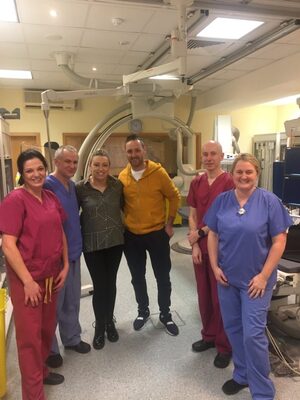
I was’t directly involved in Mary’s care but I am enormously proud of the skill and dedication of my colleagues here in CUH who were able to save her life.

She came to our hospital, our stroke service, at the most critical time in her life and received emergency care that is comparable to any hospital in the world.

There hasn’t been any clinical intervention in medicine within the last decade as effective as stroke thrombectomy.

Uniquely, for medical advances, it is also hugely cost effective, with large reductions in rehab and social care costs.

We have performed 77 thrombectomies in CUH in 2019, a 50 per cent increase on previous years. We have treated patients from Cork, Kerry, Tipperary, Limerick, Waterford and Clare.

We have had many outcomes as good as Mary’s, albeit few as dramatic.

We still have work to do to further develop CUH as a comprehensive stroke service with a properly equipped and staffed stroke unit that can provide comprehensive stroke care to the people of Cork and Munster, every hour of every day, every day of the year. We are making progress.

Mary is back at home with her husband Damian and her now five-week-old son, Noah.

Her daughter Priya is back playing on her iPad.

(An enormous thank you to Mary and her family for giving us permission to tell her story).

Via Dr Liam Healy

Broadsheet.ie
