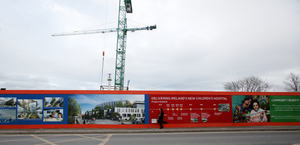
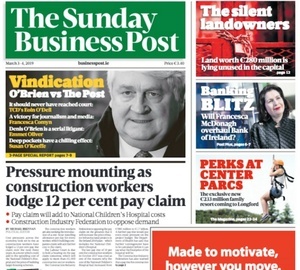

From top: Construction at the site of the National Children’s Hospital; The Ccver of last Sunday’s Sunday Business Post; Michael Taft
In recent days employers have claimed that rising construction wages are a significant contributor to high prices in the residential and infrastructural sectors.
Not only do these claims not hold up, they are crude attempts to divert attention from the real drivers of prices.
On the front page of the Sunday Business Post (behind paywall) there was a claim that:
‘The last pay rise of 10 percent for construction workers in October 2017 was cited as one of the reasons why the cost of the National Children’s Hospital had increased from €980 million to €1.7 billion.’
This is groundless.
The Construction Industry Federation (CIF) states that labour makes up 40 percent of the overall costs of construction (we will see below this is highly contestable).
So if labour made up 40 percent of the original estimate of €980 million – that would come to €392 million. A 10 percent pay increase would add €39.2 million.
However, the cost of the project ballooned by over €700 million. The pay increase made up only a fraction of the project increase – 5 percent. So where did the other 95 percent come from?
Now that construction workers have lodged a pay claim for a four percent annual increase over the next three years, the CIF is at it again:
‘An increase in labour costs would add to the cost of construction for a house builder . . . This in turn would result in an increase in the cost of the house to the purchaser. Driving up the cost of housing at this time would only serve to exacerbate the current housing crisis.’
It’s hard to know where to start in de-constructing this assertion. So let’s start with some comparisons.
European Comparisons
Employee compensation in the Irish construction sector is low by comparison with our peer group in the EU.

Irish construction compensation would have to rise by 17 percent to reach our peer group average, and a lot more to reach the table leaders.
Recently, Irish compensation has been increasing faster than our peer group (after a long period of stagnation). In 2018, Irish construction compensation rose by 4.1 percent; our peer group rose by 3.1 percent.
But our employer class shouldn’t worry too much. At this rate, Irish compensation won’t catch up to the average until 2033.
Wages and Prices
The CIF worries that higher wages will fuel higher house prices. But wages make up only a small proportion of the cost of residential and commercial construction.
There are two ways to measure this: the production value approach (compensation as a percentage of production) and the value-added approach (compensation as a percentage of combined non-labour and labour costs).
In both measurements, Irish proportions are much smaller than our peer group – meaning wage increases would have a smaller impact.
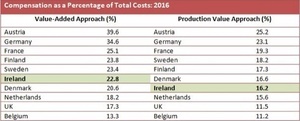
Not only is Irish employee compensation in the bottom half of the table in both measurements, this shows that employee compensation is between 16 and 22 percent of costs.
The difference is that the production value includes value-added (that is, both wages and profits). This is a far cry from the CIF’s claim that wages make up 40 percent of costs.
A four percent pay increase would represent less than one percent of total costs in either measurement. Even if we took the CIF’s claim that employee compensation makes up 40 percent of the costs, a four percent increase would still have a minor knock-on effect: 1.6 percent of production costs.
That’s if you believe there is a relationship between wages, costs and prices.
A Sector Detached From Costs
Irish house prices long ago detached themselves from costs and wages. Prices operate on a different plane.

In the decade prior to the crash, the construction cost index rose by 68 percent. During that same period new house prices rose by 214 percent – more than three times the rate of costs. Not much of a relationship.
Between 2007 and 2012 – when new house prices bottomed out – construction costs rose by one percent; new house prices fell by 30 percent. Not much of a relationship there, either.
So what’s been happening recently?

Here we go again. Between August 2012 and August 2017 (the last month we have data for construction costs), new house prices rose by 59 percent; construction costs rose by 4 percent.
One more piece of evidence that house prices and construction costs don’t relate to each other.
Here’s something provocative. The Labour Costs Index shows that construction wages rose by four percent in 2018. National new house prices rose by less than one percent; Dublin new house prices actually fell by four percent. I won’t suggest that if we increase Dublin building workers’ wages, Dublin prices will fall further.
Instead, we see no relationship.
Of course there is no relationship. As Orla Hegarty, Lorcan Sirr and Mel Reynolds (this is one Troika I would like to see take over government housing policy) have consistently shown, house prices are determined by the interaction of a number of factors – land prices, developer margins, credit availability and cost, planning and design, etc. And profits.
Profits
There is some data that the CIF are reluctant to highlight.

Value-added is made up of two components – profits (gross operating surplus) and employee compensation. The higher the profit percentage, the lower the wage percentage: it’s a zero-sum relationship.
And profits in the Irish construction sector are doing quite well. 40 percent of value-added is captured by profits. This is lower than the UK – where low wages and bogus self-employment are even more than here – but much higher than a number of other countries.
Another way to measure profits is as a percentage of turnover, or sales.
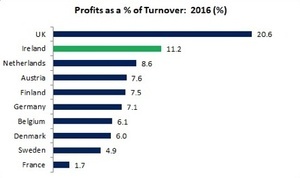
This measurement – Gross Operating Rate – shows profit as a percentage of turnover. Again, we see Ireland at the top (bar the UK) and well above many other peer-group countries.
Employers will point out that this represents a catching up, that profits were on the floor during the recession. It is true that profits crashed in the years following the crash. This was just as unsustainable as the white heat frenzy prior to the crash. But there’s catching up, then there’s overtaking by a wide margin.
* * *
So what have we found?
Irish construction wages trail our peer group average by a significant amount and on current trends will take well over a decade to reach that average.
Wage increases have only a fractional impact – whether that’s measured as a percentage of production costs or of the non-value-added component.
There is no relationship between wages and costs, and new house prices. There hasn’t been one for a long, long time.
Irish profits in the construction sector are much higher than all other countries in our peer group, bar the UK.
In short, the CIF is making disingenuous arguments about costs and ignoring the real drivers in prices. But there is a wider lesson here; namely, that government policy must focus on establishing a long-term relationship between house prices and construction costs.
If prices mirrored construction costs since 1997, the average national house price in 2016 would have been €177,000 instead of the actual price – €314,000.
If we don’t link prices with costs, we’ll continue to suffer the roller-coaster of booms-and-busts in the construction sector – with all the damage to the economy that we know only too well.
Michael Taft is a researcher for SIPTU and author of the political economy blog, Notes on the Front. His column appears here every Thursday.