

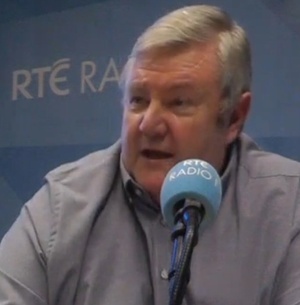
Derek Mooney (above) overhears Trump and anti-Trump voices in Washington DC this week (top pic by Derek)

I write this week’s column while sitting in my hotel room, very late on Monday night/Tuesday morning. I am about 800m from the Pentagon, just outside Washington DC.

I am mainly here on business, though I should make it clear that my proximity to the Pentagon is completely unrelated to my work. I am at Pentagon City because hotels here cost a lot less than those downtown.

It is a trip that I usually make around this time of this year, though this time I decided to take a few ‘personal days’ beforehand rather than afterwards.

I only mention this as a way of explaining that this is my first time being in the US for Veterans Day. Veterans’ Day in the U.S. corresponds with WWI Armistice day – the eleventh day of the eleventh month. Though it was officially on Sunday, yesterday (Monday) is the public holiday in lieu.

It is why this hotel, indeed most of the local bars and restaurants, have been thronged for the past few days with military veterans of all ages, along with their families, coming to visit the nearby Arlington military cemetery.

Strolling to a local mall on Sunday, I was struck by the number of times I heard young locals say “thank you for your service” to ex-servicemen and women they passed on the street.

While this is perhaps not so unexpected in an area so filled with people who either work in the Pentagon or are associated somehow with the military, it is still unusual to hear it and – notwithstanding the legitimate concerns about US military actions in various parts of the world – even a bit moving.

If only our government held the service of those currently serving in Óglaigh na hÉireann, the Irish Defence Forces in such a high regard, but that is an article for another day.

Given the number of out of town veterans about, I tried to channel my inner Maeve Binchy and began earwigging conversations in bars and restaurants to hear what, if anything, they were saying about President Trump.

It was mixed result.

It ranged from the 32-year-old barman, in a great neighbourhood bar about an hour’s drive south of Arlington, who talked about how he can only find bar work despite having a degree in economics, to the local baristas who have recently come to live in the US and build their futures here. These were not Trump voters.

I did overhear a few possible Trump voters, some even in the bright red “Make America Great Again” Maga baseball caps, but not that many. My heart started to lift on Sunday morning as I listened eagerly to a married couple, in their 60s, at a neighbouring table at breakfast, speak disapprovingly of Trump’s behaviour in Paris.

While both were genuinely irritated and even embarrassed by Trump’s failure to attend some events due to rain, it was still not a deal breaker to them. “At least he gets things done”, said the wife, as they discussed Trump’s counter balancing merits. Her husband agreed, citing the number of new jobs and record stock market highs since Trump took the White House.

Remember this is a conversation between them. I was just an eavesdropper. That said, I nearly had to be restrained from intervening, shouting: “So what? Mussolini made the trains to run on time… was that worth the brutal fascism?”.

Fortunately, I didn’t. Partially because this old Mussolini trope is false – Fake News so to speak – but mainly because they were just a nice couple having a private chat as they watched the news reports from the Paris Armistice day commemorations.

They were not festooned with Trump hats or National Rifle Association t-shirts. They were a courteous, well-spoken, decent, middle-of-the-road couple in Washington for Veterans’ Day.

They did not match the mental image we have of Trump supporters, but could it possibly be that our mental picture of Trump voters is warped and that they represent most Trump voters?

Yes, they were both white. Yes, they were both in their sixties. But they were also something else – (a) they were not from a big city – from what I could glean in their chat with the waitress, they came from rural Carolina and (b) neither were college-educated – though this is more a hunch than a statement of unimpeachable fact.

What they were was an illustration of the reality that the big political divide in the U.S. today is between those who live in the large urban sprawls and those who live in rural, small town America. It is also between those with a third level education and those without one.

The divide is about a large part of America that feels passed over.

This is the America that has not felt the economic benefits of the success of the tech giants or globalisation. It is also a big chunk of America, especially in the old industrial heartlands of small-town Ohio, Pennsylvania, West Virginia and Michigan that once solidly voted Democrat.

Like it or not, there is a sizeable section of this non-urban, non-college population who perceive Trump as delivering on the things he promised. It is not a majority view – indeed the results of the midterms point to Trump having a major battle on his hands for re-election in 2020 – but it is still a sizeable and consistent minority.

Back in 2016, Trump won the Presidency with 46% of the national vote. Last week he secured a 45% approval rating. True, it was lower a few months back, but while some supporters may abandon him briefly, he still has a solid wall of support that will not desert just because the “big city” newspapers and national TV pundits don’t like him.

If anything, this “urban” disapproval may be one of his biggest plusses – though the biggest factor in his 2016 win still remains the fact that he was running against the second least liked major-party nominee of all time: Hilary Clinton. By the way, Trump was the first.

Where the Democrats won last week, their margins of victory (in the House of Representatives contests it was about +7%) were roughly in line with Trump’s net margin of disapproval (over approval) which has lately been around -9%. The health warning which accompanies this is, of course, the fact that Hilary Clinton (even with her historically high disapproval rating) won the popular vote in 2016 and got 2.9 million more votes than Trump.

What seems to have changed since 2016 is not that the Democrats have gotten their act together, but rather than the increasing number of self-identifying independent voters, especial ly those in suburban America, are backing Democrats.

The strong showing of Beto O’Rourke in once solidly Republican Texas may be a pointer to where the Democrats need to go. In 2016 Trump beat Clinton by a margin of around 800k votes (4.7million to 3.9 million). Last week O’Rourke slashed it back to just 200k votes.

To be fair, I know I am reading far too much into a few overheard conversations from a three-day stay in an area whose local voters, most of whom are on the Federal Government payroll, overwhelmingly voted Democrat, but hey, if you can’t trust the opinion of the guy serving you a few pints of Yeungling, who the hell can you trust?

Not the President of the USA if it is raining, it seems.

Derek Mooney is a communications and public affairs consultant. He previously served as a Ministerial Adviser to the Fianna Fáil-led government 2004 – 2010. His column appears here every Tuesday Follow Derek on Twitter: @dsmooney

Developer Gerry Barrett (top) and the CIE site at Ceannt Station, Galway

G Van Helsing writes:

Are you able to explain how Galway developer Gerry Barrett was selected to develop the CIE site at Ceannt Station, a site of more than 8 acres in the centre of the city?

This is the same Gerry Barrett, NAMA alumnus, who last November was in the high court trying to stop a receiver being appointed to seven of his insolvent companies that owed Deutsche Bank almost 700 million euro.

How can this guy be given one of the biggest developments in the country when his existing companies seem unable to pay their debts? He even has a site that backs onto the CIE land. Nice and Handy!  If this is where failure gets you, why would anyone be bothered with success?

Anyone?

A spectacular ‘lava flow’ descending from an abandoned building in the Catalonian town of Olot composed of 10,000 fortune teller origami polygons.

Lit from below and wreathed in fumes from smoke machines, the installation – created for the LLUÈRNIA festival of light and fire by David Oliva of SP25 Arquitectura and Anna Juncà of Atelier 4 –  takes its cue from the dormant volcanos that surround the town.

colossal

From top: Free public transport is central to a Universal Basic Service; Michael Taft

We have all heard of Universal Basic Income – the proposal that everyone receive an income sufficient to meet basic needs, regardless of income or employment status.

Now, there is another proposal from the University College London’s Institute for Global Prosperity. They are proposing Universal Basic Services (UBS).

They describe it as:

‘The provision of sufficient free public services, as can be afforded from a reasonable tax on incomes, to enable every citizen’s safety, opportunity, and participation.’

Free public services: they claim this will meet needs more directly, increase economic efficiency and reduce costs, and buttress the social fabric by focusing on public needs.

Based in the UK, the ICP’s starting point is the National Health Service – a free service based on need. They take this principle and apply it to:

Education

Shelter

Food

Transport

Information

Democracy & Legal Services

Some of these are fairly self-explanatory. Education should be free – from early years to third level. Households shouldn’t have to sacrifice to educate their children (education, in any event, is a public good) while students shouldn’t have to start out their working life in debt. And in Ireland we would have to include free health.

Other candidate services for a UBI are a bit more debateable. For instance, it is proposed that social housing be doubled (1.5 million in the UK) and be provided for free on a needs basis.

In this proposal, shelter is not a universal service but a free means-tested service. Similarly with food – UGL proposes to provide one-third of meals free to those experiencing food poverty (8 percent of UK population). Again, this is not a universal service but a free means-tested approach.

The proposal for free public transport is on more solid ground. A number of cities throughout Europe provide free public transport – including ferries and bike rental schemes.

In Ireland, nearly a million people have free travel passes, or more than one-in-four adults. There are further free travel schemes for island residents (e.g. Tory Island residents receive 8 free journeys on the seasonal helicopter to the mainland). So the principle of free travel is established for a significant number of people.

The UGL also propose free information which would include a household package of free basic phone, Internet and the BBC TV licence fee. Certainly, if digital participation is a necessity in the 21st century, then there is a logic for free internet.

While free universal public services are appealing, the perfect is the enemy of the good. Ireland struggles to reach the level of public service spending in our EU peer-group, never mind providing public services for free.

Ireland is a bottom dweller. Just to reach the second lowest spender – Austria – we’d need to increase spending on public services by €5.6 billion; to reach Danish levels we’d have to increase spending by over half, or nearly €19 billion (gulp).

However, UBS can help reframe the debate over public services. For instance, cost-rental or income-linked housing can deliver affordable housing to a huge swathe of the population.

Regarding public transport, it’s not just fare levels – it is also about urban planning (costs fall in higher density areas), frequency, ease of access and comfort.

However, a flat-rate fare of €1 for all Dublin public transport could provide an incentive to move from car-reliance and reduce costs for passengers.

We can also innovate the way we pay for certain services. I have written about turning the TV license from a flat-rate payment into a fractional charge on income. This would turn a regressive charging structure into a progressive one; as well as eliminating administration and enforcement costs, and license-evasion.

And if you think that providing basic internet to all households would be costly, it would come to only 0.6 percent of gross personal income (but the immediate issue is coverage, particularly in the rural areas).

There are other services we could look at. For instance, why shouldn’t childcare be free, like early childhood and primary education?

Recently, TASC proposed that childcare workers be paid directly by the state with childcare providers given a capitation grant for each child in their service. While there still might be a household co-payment, it would not constitute a bar to labour market entry or a burden on parents.

A key element in the UGL’s proposals is a radical decentralisation of public services to local and regional government. Once again, Ireland is a bottom dweller when it comes to local government spending.

In the Nordic countries over half of all public spending comes through local government, compared to 7.5 percent for Ireland. This may help explain why there is a general consensus in Nordic countries for higher spending – at local levels accountability is potentially enhanced.

However, ambitious and radical reform would be needed for Irish local (or sub-central) government to have the political and economic capacity to administer public services.

Most of all, UBS, in reframing the debate, could promote an inclusive and authentically democratic dialogue about the nature, operation and delivery of public services – a dialogue not just of ‘expert’ consultants but one that is extended throughout civil society, rooted in the experience and ideas of the producers (workers who deliver public services) and the users of those services; that is, all of us.

The emergence of public services in the late 19th century – education, health, sewers, water, waste collection, energy – was the foundation of social modernisation. We need to launch a new debate over the foundations of a 21st century public service infrastructure.

Universal Basic Services should play a significant role in that debate.

Michael Taft is a researcher for SIPTU and author of the political economy blog, Notes on the Front.

Rollingnews

Liberty Hall in Dublin ahead of a visit by Aung San Suu Kyi in 2012

Amnesty International has withdrawn its Ambassador of Conscience Award from Aung San Suu Kyi “in light of her shameful betrayal of the values she once stood for”.

Last year, Dublin City Council stripped the Myanmar leader of her Freedom the City of Dublin award following her indifference to the persecution of her country’s Rohingya people.

Via Amnesty International:

Yesterday, Amnesty International’s Secretary General Kumi Naidoo wrote to Aung San Suu Kyi to inform her the organisation is revoking the 2009 award.

Half way through her term in office, and eight years after her release from house arrest, Naidoo expressed the organisation’s disappointment that she had not used her political and moral authority to safeguard human rights, justice or equality in Myanmar, citing her apparent indifference to atrocities committed by the Myanmar military and increasing intolerance of freedom of expression.

….When she was finally able to accept the award at an event held in Dublin in 2012, Aung San Suu Kyi asked Amnesty International to “not take either your eyes or your mind off us and help us to be the country where hope and history merges.”

Amnesty International Ireland chief Colm O’Gorman said:

“When we honoured Aung San Suu Kyi here in Dublin, it was for a Myanmar that would protect and defend the human rights of all. This is what Irish people in their tens of thousands had campaigned for decades to achieve.

We will continue to fight for justice and human rights in Myanmar – with or without her support.

Amnesty International took Aung San Suu Kyi’s request that day very seriously, which is why we will never look away from human rights violations in Myanmar.”

Amnesty International Ireland

Previousaly: Aung San Suu Kyi on Broadsheet

Rollingnews

The mesmerising shenanigans of a large spiral of cut aluminium manipulated by designer and fabricator Chaz Capobianco (who may just have invented the new Slinky).

awesomer

Broadsheet.ie