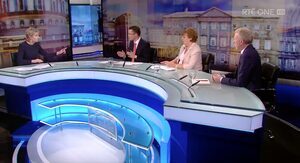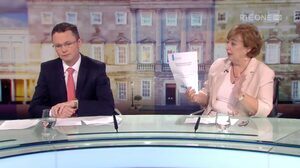




From top: Minister for Arts, Heritage and the Gaeltacht Josepha Madigan (centre), who has said unless regulated social media poses “one of the biggest threats to western democracy” with Minister for Finance Paschal Donohoe (left) and Taoiseach Leo Varadkar at a Project Ireland event in the National Gallery last April; Bryan Wall.
What is not debatable these days is the general collapse of the standard and traditional style of media organisation which came to dominate our lives throughout the 20th century and the early years of this century.
Newspaper circulation numbers have plummeted over the last decade and a general mistrust of the media prevails. This has been inevitable given the rise and ubiquity of the internet alongside the rise of social media.
Now the traditional media hierarchy, in which people were the consumers at the bottom of a chain with the content creators in the media at the top, is no longer predominant. With the internet and social media it is now possible to bypass this top-down hierarchy.
People have been able to find other non-mainstream sources of information which carry stories and ideas that would struggle to find light in traditional media outlets.
Media has become more democratic in the sense that now anyone can become a reliable source of information with a minimal amount of resources.
Presumably given this ubiquity of social media, there are now calls to have it regulated.
Josepha Madigan, the Fine Gael Minister for Culture, Heritage and the Gaeltacht, has stated that unless social media is regulated, it “could pose one of the biggest threats to western democracy”.
Her reasoning for this is the “growing body of evidence that the Brexit vote and the last US presidential election were significantly influenced by foreign bodies through spend on social media.”
Therefore, she has called for regulation of social media and has asked her fellow ministers to “prioritise the introduction of legislation and regulation in this area at both a national and EU level before the end of the year.”
When I contacted her office regarding her claims of the “growing body of evidence” that the US.presidential elections and the Brexit vote were influenced by “foreign bodies” — undoubtedly she means Russia — via social media, I received no response.
Further to this, it was reported in The Irish Times in late August that the Department of Employment Affairs and Social Protection (D.E.AS.P.) is currently “seeking tenders for media monitoring”.
Included in this is the monitoring of social media for “‘keywords’ that may flag issues to it” along with providing “details of what people are discussing in public threads on Twitter and Facebook, and other platforms.”
A representative of the Irish Council for Civil Liberties (ICC.L) told me the organisation was “perturbed by reports that DEASP is soliciting tenders for social media monitoring.”
They are also “concerned by the power and privacy implications of this same agency potentially monitoring and collecting data about the personal and political opinions of those dependent on the its essential services.”
On the issue of social media regulation, the ICCL is in favour of such a move given the Cambridge Analytica scandal and the ability of Google to track its users at all times regardless of what privacy settings have been selected.
The ICCL spokesperson stated that regulation “would encourage increased transparency from these corporate entities, including how they human rights proof their policies and procedures.”
The Press Ombudsman also supports the latter move.
When asked, their spokesperson told me: “that it is time for social media to accept its responsibility” and “abandon[…] the argument that social media isn’t a publisher.”
This means that social media groups must “put in place transparent self-regulation processes that can be scrutinised for their effectiveness.”
If this self-regulation does not work or meet previously set standards, the Press Ombudsman believes “national governments and international agencies such as the EU need to put in place statutory frameworks whereby social media that fails to live up to acceptable standards can be brought into line.”
Nonetheless, “considerable caution” has to be shown in order to “avoid the accusation of censorship or restriction of freedom of expression.”
To that end, governments and agencies tasked with the regulation of social media “must recognise that there is a balance to be achieved between freedom of expression and the need to protect people from the misuse of that freedom.”
Fianna Fáil has also published a report on the issue of social media and its effect on journalism.
Arguing that “Professionally produced journalism is an essential condition for the survival of modern democracies”, the report goes on to call for the government intervention to support journalism and publishers given “the significant erosion of publisher revenues” due to the proliferation of the internet.
Among other things, such intervention would take the form of a Minister for the Media, who “would have overall responsibility for media including news publishing”, along with expanding the role of the Broadcasting Authority of Ireland (B.A.I.), Ireland’s media regulator, to also encompass social media.
In Paschal Donohue’s budget speech last week, one recommendation of the report, reduction of VAT rates on newspapers, was introduced. Now the rate of VAT has been lowered from 23% to 9% for digital publications and digital versions of physical publications.
The report also calls for “innovative new schemes to support the work of journalists, through the dispersal of Grant [sic] aid” and providing bursaries, fellowships, and “training and educational opportunities”.
One of the ways this could be funded is by imposing a “digital advertising levy” which would ensure “that the success of online platform does not come at the cost of independent public interest journalism.”
In an apparent case of good timing, early last month the European Parliament voted in favour of the so-called Copyright Directive.
In the directive proposal it is suggested that a “licensing market between rightholders and online content sharing service providers” is developed.
If passed in the final vote next year, the directive, specifically Article 11, would allow for publishers to demand the creation of this market in which licence fees are paid to them in return for links to their publications being shared online.
Both the decrease in VAT and the European Parliament voting in favour of the Copyright Directive were welcomed by Newsbrands Ireland, “the representative body for all national newspapers, print and online” according to its website. Their chairman is Vincent Crowely, who was previously chairman of INM.
Newsbrands wrote that the directive will “safeguard the future of journalism in Europe” and that the VAT decrease will “reduce the cost of access to quality, independent Irish journalism for people who access their news online.”
Clearly this aligns with the recommendations in the Fianna Fáil report.
One could argue that this seems to be an attempt to legally codify censorship and prop up the publishing industry at the same time.
But the former explanation ignores the fact that social media companies already take steps to limit the access of certain groups and organisations to their websites and services.
They appear to have their own regulatory system in place but whose details are not known to those outside the companies in question. Plus technology companies and governments often work hand in hand already when it comes to monitoring and censoring people and organisations.
Last year ‘The Intercept’ reported that both the Israeli and US governments were directing Facebook to delete certain accounts, including those of Palestinian activists.
More recently, Facebook deleted the English-language account of teleSUR, the television network based in Venezuela whose regular reporting tends to be highly critical of American foreign policy and the actions of other Western states.
And just last week Facebook and Twitter deleted the pages of hundreds of alternative media organisations.
On the surface, then, it may seem as if regulation of social media will be of benefit to underfunded newspapers and publishers, given the power that social media already holds in terms of their ability to block information as well as spreading false information.
But government intervention in this case must be questioned.
This is especially so when governments have a history of spying on journalists and pushing false narratives to their mouthpieces in the media.
Judith Miller of The New York Times is an egregious case of the latter, with her role in cheerleading the 2003 invasion of Iraq now being infamous. With the revelations of Edward Snowden there can be no doubt that journalists are prime targets.
Even as far back as 1982 the Irish government was discovered to have been wiretapping the phones of a number of prominent journalists.
This would eventually result in the resignation in 1992 of the then Taoiseach, Charles Haughey, given his role in approving the wiretaps nearly ten years earlier.
With this in mind we should be wary of any government intervention in the realm of social media and the internet more generally.
Along with the proposal to directly fund journalists, as laid out in the report issued by Fianna Fáil, it is now apparent that there is a move underway to further tighten the reins on all media. Social media giants are themselves already playing a part in this.
But with government intervention the possibility of censorship and a chilling effect on political activity and media no longer seems an abstract that only applies to those we consider “others”. It could very soon become a norm that applies to all of us and which will have untold deleterious and detrimental effects on our societies and our ability to dissent.
And although social media in its current form is far from perfect, it is far preferable to a state of affairs in which both technology companies and governments are aligned against those who demur and question orthodoxy.
Unless media is free and open, and that includes social media, it is a tool of propagandists and nothing more.
Bryan Wall is an independent journalist based in Cork. His column appears here every Monday. Read more of his work here