



Hot Wheels
at


Constructed from lightweight carbon fibre and featuring a ‘centre hub’ steering mechanism borrowed from motorcycle technology, the Furia Concept Bicycle, designed by Francesco Manocchio, won this ADI Eccellenze del Design nel Lazio industrial design award.
Unlike the (almost certain to be produced) real thing, this 1:1 scale prototype was 3D printed.
How Much?
at
Thud.
3stella writes:
Some predictably epic price gouging for U2 on Viagogo. 1,758.00 for a 81.00 Euro (GA) standing ticket…. 3 Arena, Dublin.

The spot where the body of a man was found this morning at Ryders Row, Dublin 1
The first of 2018…
“The man was found in a sleeping bag near Parnell Street. This death once again highlights the question of why someone would rather sleep on the streets than in emergency accommodation provided by the DRHE [Dublin Regional Housing Executive)
Trust in the hostel system is still a huge issue as many feel safer on the streets than they do in State-provided accommodation. When that is the case there are serious questions to be asked. It cannot be socially acceptable to go into another year of people dying on our streets.”
Statement from Inner City Helping Homeless (ICHH), this morning.
Homeless man found dead on the streets of Dublin (irish Examiner)
Rollingnews

Are you a tenant or a landlord?
Ciaran O’Driscoll writes:
Could you do a fierce short survey about your experiences for a friend’s college project?
With the current renting and housing situation in Ireland at the moment, I know many of you, like me, will have a lot to say about it.
The survey only takes a few minutes, and my friend and her project group would be delighted to get as many responses as possible.
Survey here
Rollingnews
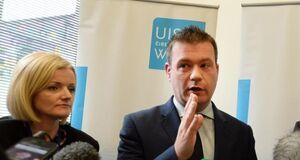
April 2015
Elizabeth Arnett, head of communications at Irish Water, with Alen Kelly, then Minister for the Environment, defend the Irish Water shambles.

Yesterday
Elizabeth Arnett, now head of corporate strategy at Ulster Bank, defends the institute’s tracker policy described as “robbery’ at a Joint Public Accounts Committee yesterday.
Good times.

For the weekend that’s in it.
Sunday, 4th of March, 2012.
A drizzle dampened Paris.
This, the rescheduled fixture from February that was frozen off.
The game described as a “classic” by a big corporate sponsor on Youtube (above) some years later, was anything but, despite the best efforts of Tommy Bowe (top).
A despondent Gerry Thornley in the irish Times, lamented:
Thus, no less than the French and perhaps even slightly more so, Ireland were left rueing a first draw with Les Bleus since the championship winning year of 1985 and first in Paris since 1950, and their first of any kind since the 20-20 draw with Australia in Croke Park in November 2009….
Merde.
This is the one that definitely got away (Irish Times)
Meanwhile…

Fake shoulder to fake shoulder.
France Vs ireland Vs Superbowl
Rob O’Loughln writes:
What with the weekend that’s in it..


From, top: Maurice McCabe And Lorraine McCabe; From left: Former Garda Commissioner Noirin O’Sullivan; Supreme Court judge Peter Charleton and former Minister for Justice Frances Fitzgerald
Today.
At the Disclosures Tribunal in Dublin Castle.
Head of HR at An Garda Siochana John Barrett will continue to give evidence.
Yesterday, he told the tribunal that former Chief Administration Officer of An Garda Siochana Cyril Dunne told him “we are going after him in the Commission”.
He has said he believes this occurred on May 13, 2015 – the day before the O’Higgins Commission of Investigation began.
He was to bring documentation supporting this claim to the tribunal this morning.
Meanwhile, Supt Noel Cunnigham and retired Chief Superintendent Colm Rooney are scheduled to give evidence once Mr Barrett is finished answering questions.
Separately…
Yesterday, at the end of the former Minister for Justice Frances Fitzgerald’s evidence, she had this exchange with Supreme Court judge Peter Charleton who is overseeing the tribunal.
Judge Peter Charleton: The last matter I wanted to ask you about I think was this whole thing of, forgive a kind of a male sporting term, a game changer, this question was asked of Ken O’Leary, and he said, look, I knew there was an allegation against Maurice McCabe, or at least this is what I said to him, I knew that there was a ruling by the Director of Public Prosecutions that this does not amount to a sexual assault, it doesn’t amount to an assault at all, even if there were no issues as to credibility. Now, did you actually know the text of the DPP’s letter of, I think, the 5th May 2007? Had you ever actually read that letter in the context of this?
Frances Fitzgerald: I don’t believe that the — I’m not absolutely sure, but I don’t think the DPP’s original letter was available in the Department. It might have been made available to the IRM.
Charleton: Yes.
Fitzgerald: And maybe in that context. But I may have seen it in that context.
Charleton: “Yes. And did you sit down and read the file? ”
Fitzgerald: Yes, I would have. The IRM file? Yes.
Charleton: No, no, I mean the original investigation file?
Fitzgerald: No, no, no.
Charleton: You didn’t?
Fitzgerald: Never. That was very much within the IRM.
Charleton: Yes. Because in doing that, I suppose, you get a good sense of the whole thing, and that’s the only way, in effect, to make sense of it?
Fitzgerald: Yes.
Charleton: And again it’s not a criticism.
Fitzgerald: I don’t believe I did, yes.
Charleton: Mr. O’Leary said the following; he said, look, in the event that it had come to my attention that counsel for the Garda Commissioner had been instructed by the Garda Commissioner to actually accuse Maurice McCabe of sexually assaulting a child, that would have put an entirely different complexion on it, it would have brought it to a completely different level and he would have gone in to you straightaway. Now, obviously that never happened. But were you to have — were that to have been the information that was put before you, would you have reacted differently or thought about matters differently or —
Fitzgerald: Well, if that situation had arisen, effectively what you would have a Garda Commissioner doing is bringing up an issue that had been dealt with by the DPP, that had been dealt with by the Independent Review Mechanism and GSOC, which she would have been aware of, I think, at that point, if the dates are right, and that would be a very extraordinary situation. If an allegation that had been disproved by — you know, was not taken as — that there was any basis to it, and the Garda Commissioner was doing that, that would be a totally different situation, and I imagine if that happened at the Commission of Investigation, that I believe that there would be a different note going from the CSSO to the Attorney and there would be different issues being raised, and at that point then there would be a different discussion.
Charleton: And which arising out of that is, I wouldn’t, I suppose, be any kind of a lawyer if I didn’t know about Cabinet confidentiality, and I’m not asking you to breach that, but it’s become increasingly stark every time I read paragraph (e) that I have been required to investigate whether false allegations, plural, of sexual abuse were inappropriately relied on by Commissioner O’Sullivan to discredit Maurice McCabe. Now we know that didn’t happen. But where did the notion that anybody had made false allegations of sexual abuse and put them to Sergeant McCabe at the O’Higgins Commission ever come from? If you can’t answer that, don’t answer it. But I’m just tending to wonder why is it there?
Fitzgerald: Yes. Well, it’s very hard to say exactly where it arose from. But it seemed to be — it seemed to be an innuendo that, you know, was around, and that — in terms of, I think there may have been, there may have been some media coverage in relation to it, and I suppose there perhaps was confusion between the investigation into the Ms. D complaint, which was about the investigation as opposed to the original allegation. But certainly we felt that it needed to be in the terms of reference —
Charleton: Yes.
Fitzgerald:— because it had arisen from all of this.
Charleton:Sure. Even if that were so, why is there a plural on it?
Fitzgerald: The plural is?
Charleton: “False allegations of sexual assault”. I’d just better get the exact words.
Fitzgerald: Yes.
Charleton: I’m sorry, just give me a second to look back at it. “False allegations of sexual abuse”. Allegations.
Fitzgerald: Yes. Well, it was allegation. That may be — that may be referring to a sense of it being out there with other people, the allegation. But you’re right, it is only about, clearly only about the allegation.
Charleton: Yes. But I’m required to investigate into a number of, it could be from anything to two to God knows, the awful cases that have been seen in the courts —
Fitzgerald: Yes.
Charleton: — where there is — you know, and the swimming — or the swimming case or the gymnastic case in America recently. It’s rarely one. Why the plural, do you know? And if you don’t know, you don’t know.
Fitzgerald: I mean, I would have taken advice on the terms of reference at the time. And I can’t — I can’t say on that.
Charleton:: Thank you very much.
Fitzgerald: Thank you.
The tribunal continues today. Follow Olga Cronin’s coverage here.
Previously: Unconscionable
Questions For Frances

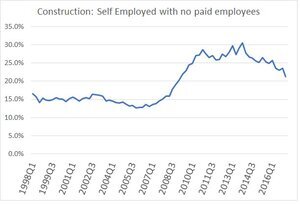
Tom Parlon (top) of the Construction Industry federation (CFI) believes bogus self employment in the construction industry is ‘grossly exaggerated’
In a recent interview with TheJournal.ie, Director General of the CIF Tom Parlon dismissed claims from a new construction union called ‘Connect’ that it would eliminate the Scourge” of bogus self employment in the construction industry.
Assiduously avoiding the term ‘Bogus Self Employment’, Tom told TheJournal.ie that there has been a move away from direct employment, not just in Ireland but internationally. However, he said the scale of this has been “grossly exaggerated”
There has indeed been a move away from direct employment in the construction sector.
In 1998, the share of workers in the construction industry classified as self-employed was 16%. The Office of the Comptroller & Auditor General was, at that time, concerned that a significant portion of those classified as self employed were in fact bogus self-employed.
Partly because of the C&AG’s concerns, the Revenue Commissioners undertook a special program of 6,200 visits to Principle Contractors in the construction industry. During the visits, the status of 63,000 sub-contract situations was examined.
12,000 (19%) of those sub-contract situations were not genuine self-employment, they were bogus self employment.
In 2001, concerns were expressed at the Public Accounts Committee that misclassification was still rife in construction.
The then Chairperson of the Public Accounts Committee, Jim Mitchell, ordered a similar special program of visits to Principle Contractors in the construction industry. The results of this PAC investigation exposed the same high level of bogus self employment in the construction industry – circa 20%.
Over the following 6 years, the rate of self-employment in the construction sector fell almost 3% to 13% with a commensurate reduction in the percentage of Bogus Self Employed. The investigations instigated by the C&AG and the PAC were pivotal to that decrease.
In July 2007, Tom Parlon took up a position as Director General of the Construction Industry Federation. Within five years, in an unprecedented explosion unseen anywhere else in Europe, the percentage of workers in sub-contract situations in the construction sector more than doubled before peaking at almost 31% (Refer to QNHS data below).
Extrapolating from the only the widespread investigations available, instigated by the C&AG and the Public Accounts Committee, Bogus Self Employment in the construction sector was over 40% in 2013 and is currently running at almost a third (30% – 33%) of those classified as self employed in the construction sector.
In 2015, the Irish Congress of Trade Unions released a report which states that Bogus Self Employment in the construction sector was costing the tax payer 80,000,000 euro in PRSI per year.
This figure was based upon 30,000 – 40,000 sub-contract situations but later Dáil replies state that the actual number of sub-contract situations is in excess of 100,000, resulting in a loss to the taxpayer of circa 250,000,000 euro in PRSI per annum.
As was confirmed by the Minister for Social Welfare in recent weeks on Drivetime RTE, there are no official figures available from either Social Welfare or Revenue on Bogus Self Employment, however, the QNHS data is generally accepted as credible, unlike the Pernicious Mr. Parlon.
Martin McMahon podcasts with Tony Groves at The Echo Chamber and blogs at RamshornRepublic
Previously: Bogus Self Employment Cheats Us All
Rollingnews
