Tag Archives: MC

Community Action Tenants Union [CATU] write:

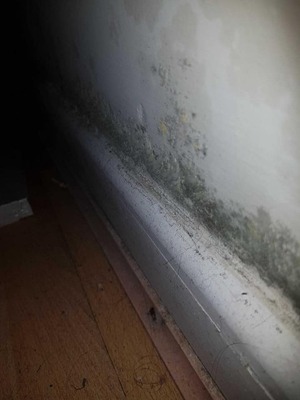
A CATU member in Tallaght is currently dealing with Ray Cooke Lettings‘ inaction on an out-of-control mould situation in an apartment, which is causing serious health problems for the tenants.The situation has been ongoing for the last three years. The letting agent is refusing to carry out inspections due to Covid, despite the fact that Ray Cooke is currently taking bookings for house viewings.

CATU Ireland (Facebook)

Lois McGrath writes:

This is my Daughter’s apartment which she pays a fortune for every month only to live in a slum. Disclaimer: no shes not a lone parent no she’s not on social welfare no she doesn’t get HAP. She just a hard working mother.

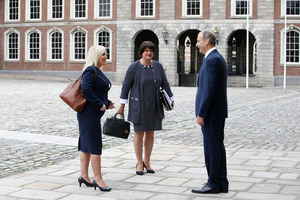
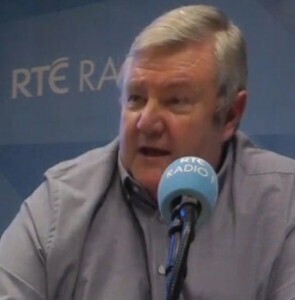
From top: Northern Ireland Deputy First Minister and Sinn Fein leader Michelle O’Neill (left), First Minister and Leader of the Democratic Unionist Party Arlene Foster (centre) with Taoiseach r Micheal Martin in Dublin Castle for the North South Ministerial Council last July; Derek Mooney

It’s never the little too little that hurts, it’s the little too much. This was Sean Lemass’ famous advice to aspiring politicians. Keep your own counsel and never say more than you need too, especially when what you are saying is not fully thought through.

Though the advice comes from an age before social media and rolling news, it applies as much today as it did in the 50s and 60s.

It is such a profound piece of political advice that I assumed I had mentioned it here before. But a word search of the Broadsheet pieces I have written over the past 5 years tells me that I’ve only quoted it here once before. That was last November in a piece I wrote about the Shared Island Unit. In it, I suggested that the Taoiseach still “has an awful lot to learn from Lemass’s practical application of vision to action.”

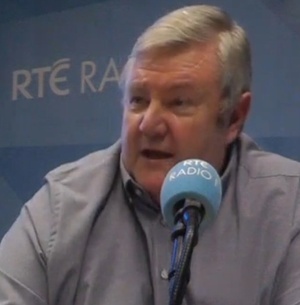
Listening to the Taoiseach’s lengthy Saturday morning interview with Brendan O’Connor on RTÉ Radio One, it appears that it is a lesson he still needs to learn, and urgently.

There is a major risk in doing a 50-minute interview when you only have 30 minutes of solid material. The temptation is to fill the gaps by musing on some interesting briefing material you recently saw.

While it is good to know that our Taoiseach likes to think about things it is still disconcerting to hear that process play out through your radio on a Saturday morning.

About 26 minutes into the interview the Taoiseach, who had already attributed our high transmissibility rates to the new UK Covid-19 variant, said that it was his understanding that the North doesn’t test for this new variant. He then doubled down on this claim saying that he could not fathom this approach and that Northern leaders had told him the variant just wasn’t an issue there.

He implied his government’s efforts to create an all island response to the pandemic had been frustrated by the political difficulties within the Northern Ireland Executive.

Micheál Martin is not completely wrong when he says there are political divisions in the NI Executive on Covid. There clearly are. The Northern response has often been the victim of political brinkmanship at the Executive between the DUP and Sinn Féin, as we saw last November when public wrangling trumped expert medical advice.

But neither is he completely right. He went way too far. He said something he need not say, for no purpose whatsoever, apart presumably from filling airtime and taking a bit of heat off himself.

Listening to it live I had the constant impression that, like us, the Taoiseach was hearing a great deal of what he himself was saying for the first time. O’Connor didn’t draw these comments out of the Taoiseach, the Taoiseach offered them up.

O’Connor had the wit to keep his interventions short and concise and not jump in. He permitted the Taoiseach to just keep talking, to fill all the silences and – perhaps – to go too far. He did.

So, what did the Taoiseach say that was so wrong? Well, for starters, his assertion that health authorities in the North do not test for the variant doesn’t stand up. Within minutes public health expert, Dr Gabriel Scally was tweeting that the Taoiseach was not being briefed properly.

More seriously, the NI Health Dept yesterday published a detailed statement responding to what it called a “misleading commentary”. This is not how anyone should wish to see the Taoiseach’s thoughts described in an official publication.

Their statement not only set out what it was doing to identify new variants, including the B.1.1.7 variant a.k.a. the “UK variant”, it also made it clear that whole genome sequencing has been in place in NI since late April.

Why the Taoiseach decided to pick this moment to be publicly critical of the North, just when Northern Ireland is beginning to move ahead of us in its pandemic response is a mystery.

Northern Ireland has vaccinated twice as many of its population as we have in the 26 counties (1.9% vs 0.9%). As of last Wednesday 166k doses of vaccine had been administered in Northern Ireland, compared to 121k here, though the daily NI vaccination rate did fall steeply over the weekend. In terms of infection spread, rates on the two parts of the island are declining in parallel is similar. Yesterday, 1378 tested positive for Covid in the Republic, compared to 433 in Northern Ireland. (The NI population is approx. 37% of the Republic’s).

While I’m willing to accept that it was not his intention, the Taoiseach’s remarks did give the impression that problems in agreeing an all-island approach were solely Belfast’s fault.

This is strongly denied by all sides of the political divide in Belfast. They have long suspected that Dublin was deflecting from its own failings at ports and airports by portraying them as the weak point. On Saturday they heard the Taoiseach say as much live on radio.

They feel the fault lies here, not there. Last November Northern Ireland’s Health Minister, the former UUP leader Robin Swann MLA, said he had written to his southern counterpart Stephen Donnelly four times since July 2020 requesting co-operation on contact tracing, but to no avail.

Swann wanted to access passenger locator forms filled in by people arriving in Dublin Airport but travelling on to Northern Ireland. Such access would allow Northern authorities ensure that these passengers self-isolated when they crossed the border.

The response from Dublin has been the same for over six months: there may be data privacy issues which we are working on. Last year, I documented just how slipshod the contact tracing system at Dublin airport was.

Martin has succeeded in uniting the DUP and Sinn Féin against him. The two parties are now united in refusing to serve as Martin’s scapegoat.

That, bizarrely, is the upside to the debacle.

Sadly, there is also a downside, one that has serious long-term ramifications.

Martin, who has spent the past few years trying to build trust with unionism, has done real and lasting damage to that nascent relationship. He allowed his unformed thoughts to get ahead of the formed ones and sounded like he was offloading responsibility on to the NI Executive.

Martin, and his external muse on Northern politics, had hoped that unionists would see the Cork-man as someone with whom they could do business. Today, the DUP and the more moderate UUP, see him as weak, equivocating, and two-faced. They saw Saturday’s remarks as gratuitous and ill-informed.

The Taoiseach’s own words have undermined the hopes he once had that unionism would, in time, engage with his Shared Island Unit (SIU). They were the little too much.

But… does this really mean the Shared Island Unit is critically damaged? Hopefully not. As I explained last November, I worried that the Taoiseach was hampering the usefulness of the SIU from the outset by insisting that it could not talk about the constitutional question.

Martin very consciously put constitutional matters, including a unity referendum, outside of the SIU’s purview in the hope that keeping this item firmly off the agenda would show unionism that he could be trusted and that they could engage with the Shared Island Unit without compromising their position.

I thought the logic of his position was flawed. On Saturday, the Taoiseach took his own logic and strangled it for no purpose.

As yesterday’s Sunday Times/Lucid Talk poll shows, support in Northern Ireland for a referendum on unity is building. The near inevitability of a second Scottish independence referendum can only drive that impetus.

My own view, as I outlined here a year ago, is that holding a referendum on unity within the next 4-5 years would be unwise, but so too would stymying an informed debate on what a future, all-island, Ireland could look like.

Whenever it is held, and it is increasingly likely that it will be held, as DUP MP Gavin Robinson said last week it will raise just as many questions for people on this side of the border as it will for those in the North, a point well made yesterday by Fianna Fáil’s Jim O’Callaghan.

An Taoiseach will have to work hard to undo the damage he has done, but he may also have given himself an opportunity to get his Shared Island Unit back on the rails, by accepting today’s new reality and allowing it to engage on constitutional issues. Maybe some good can come from his little too much.

Derek Mooney is a communications and public affairs consultant. He previously served as a Ministerial Adviser to the Fianna Fáil-led government 2004 – 2010. His column appears here every Monday. Follow Derek on Twitter: @dsmooney

RollingNews

As one door closes, another one opens…

This is the first music competition sponsored by our gracious new voucher host: Curry’s PC World.

To celebrate, the question this week is: What’s your favourite song featuring phones or phone calls?

Here’s mine.

The winner will be chosen by my repair man and sent a €20 Currys PC World gift voucher (yes, twenty big ones).

Please include video links if possible.

Lines close SATURDAY 11am.

Nick says: Good luck.

Currys PC World

Earlier: Nick’s Gone All PC

This afternoon.

Broadsheet music editor Nick Kelly bids a fond farewell to his voucher sponsor since skinny jeans were last in, thriving record store chain Golden Discs.

Currys PC World will take over voucher sponsoring duties later this afternoon.

Nick says: Thanks to Sinéad and everyone at Golden Discs. It was beautiful.

Currys PC World

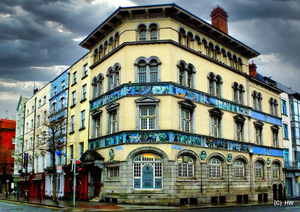
Sunlight Chambers.

Harry Warren writes:

Walking along Wood Quay towards the city centre on a miserable rainy January day, I couldn’t help but glance through the grey drizzle at the architectural monstrosities of Dublin Civic Offices.

They were erected in one of the greatest acts of cultural vandalism in Dublin’s history. The most historically significant area of Viking Dublin was literally destroyed by the then Dublin City Corporation in the name of progress during the late 1970s and early 80s.

The offices, visually having as much merit as some hideous wartime command bunkers, were dumped upon and destroyed one of the greatest and best-preserved Viking settlements anywhere in Europe.

My mood dampened. Ironically a parked cars radio was playing Morrisey’s “Every Day is like Sunday” with the classic lines “In the seaside town, That they forgot to bomb, Come, come, come, nuclear bomb”. Never a more appropriate sentiment I thought.

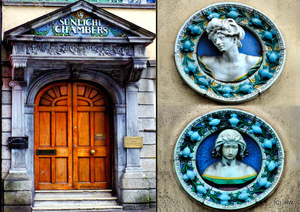
My spirits lifted when I reached Capel St Bridge (Grattan Bridge). The delightful Florentine style Sunlight Chambers building came into view on the corner of Parliament Street and Essex Quay.

Originally it was the Irish headquarters of Lever Brothers and it was elegantly designed by Edward Ould of Liverpool in 1899. The building was named after their most successful product Sunlight soap. It was one of the first soaps to be made on an industrial scale and brought the company huge success. It is still on sale today in Europe. Levers later merged with a Dutch manufacturer and became Unilever. Today you probably buy their supermarket products like Domestos, Surf, Persil, etc.

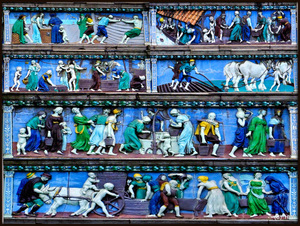
Sunlight Chambers was built to impress being Lever’s Dublin headquarters, with its renaissance stye windows on the upper floors, a red terracotta roof with wonderfully sculpted glazed terracotta faience’s or friezes on two levels. They depict animated scenes of agriculture and industry and the making of soap, along with some delightfully sculpted ladies doing washing. Sexist? perhaps by today’s standards but it is of its time and the detail and colours of the friezes are wonderful.

The sculptor, Conrad Dressler, designed and crafted the series of four roundels and twelve panels around the three faces of the building. The glazed ceramic friezes were made in 1902 in Dressler’s pottery works in Buckinghamshire. They were commissioned to fit in with W. H. Lever’s philosophy that “good art should enrich everyday life“.

So, the next time you are in that part of Dublin City, look up and reward yourself with a bit of time to enjoy the beauty of the sculptures and the story they tell.

All pics by Harry Warren

From top: Illustration from  A Journal of the Plague Year (1722) updated for 2021; David Langwallner

Daniel Defoe: The Plague Years. Review. Fictional Books (January 2023).

Mr. Defoe has just written a book about the last two years or more of unsettling unpleasantness and although it may not be published and is privately given to this reviewer it is unlike his recent text Robinson Crusoe (2017).

In fact it is not a work of fiction though like that text it does concern a man isolated and observing. Self isolating to coin a phrase de jour.

Thus Mr. Defoe stayed in London despite the advice of Doctors to chronicle the events described in his text. But where could he go after a while? No one was allowed to go anywhere except for a local walk, a brief controlled shop or a court room or hospital.

An earlier book was of course published at the time of the last plague in 1665 by a curiously similar named author.

I am led to understand by a learned Spanish friend of mine that the conditions in the city of Madrid and indeed by my publisher Dublin were much different during the plague and those countries have been more stringent in curtailing the liberties of subjects which sensible British opinion such as the noble Lord Sumption have condemned.

The slippery slope to the creation of a police state now sadly evident. I understand also that the Chinese have behaved very extremely but at great consolation to the mass of the populace but at great detriment to the impact on civil liberties not least of those in Hong Kong. The cause of liberty and indeed human rights are much imperiled by all of this embedded legislation.

Mr. Defoe chronicles the events in London of all his present citizens he encounters as The Plague visits in this year of our Lord 2020 and lasts for over two years and the sediments are still with us with the possibility of plagues to come.

He seems to have seen a lot and perhaps has not maintained all the rules about social distancing. London at least permits that limited level of freedom. Now from his observations Mr. Defoe has made a number of points of I think universal significance.

He is concerned about how astrology and the dark arts are gaining sway over the populace. He is thus obviously concerned about the quality and standard of governmental briefings. By indirection I suspect he is concerned about the rejection and denudation of scientific fact which has blurred both the standard of our public discourse and its responsiveness to this crisis and how spindoctering has taken over.

A point he might have made but did not in an escalating sense of crisis is that the rejection of scientific modes of analysis and the distrust of experts may have contributed to the present sorry impasse. But of course scientists are also manipulable and sell products too.

He is thus obviously perturbed how those who offer to the poor and gullible on the black market false information and fake solutions such as paper masks of dubious non proven validity should be disbelieved and one should not fall into that particular venus fly trap. In fact a German lawyer is accusing Pfizer of fraud and many are profiting from and have profited from social and economic collapse. Late dark capitalism.

Regrettably, he endorses as a Christian gentleman, how religion provides solace but that is the last thing we need now. Not religious solace but yes of course christian compassion to protect the wretched and poor of the earth with widening inequality.

He saliently notes how the poor and essential workers expose themselves to danger and danger to others as they irresponsibly interact of financial necessity and travel when they should not. He notes the fearlessness and the recklessness but does not, in my estimate, sufficiently weigh the desperation of Conorovirus Catch 22.

That much older text by Mr. Joseph Heller, an esteemed American author, is worthy of consideration in this context. Now the premise is simple and that is a serviceman refuses to go on a flying mission or indeed any other mission with the certain prospect of death as to do so would be insane unless of course you were a Japanese Kamikaze pilot. Thus the indication he would not want to do so is an exercise in rationality.

The Catch 22 is that demonstrates his rationality and not insanity and thus he is trapped. Or rather an impossible universe creates the problem.

The larger Catch 22 is that as depression looms or is here we have to work but by working unless privileged to do so exclusively from the comfort of homes or sealed offices we are all part of Catch 22. If we do not work then the social structure and economy will collapse and resources are dwindling and we will not be bailed out. If we do work we risk self immolation.

In a most salient passage Mr. Defoe notes:

“I only hinted before, but must more fully speak to here, namely, that men went about apparently well many dyes after they had the taint of the disease in their vitals, and after their spirits were seized as they could never escape it, and all the while they did so they were dangerous to others.”

Thus he is aware of the spreader or the silent spreader and many extreme actions have been proposed and were implemented in this respect. But what choice did they have or do we have. There is no alternative. TINA.

The watchmen figure highly in his book the enforcers of self isolation but he I think does not fully understand how their now putative and assumed authority can be abused and who shall watch the watchman as movement, liberty and dignity were and are still restricted and many arbitrary and random arrests took place and indeed random acts of civil disobedience and said powers are now given permanently to the Hobbesean state to abuse.

There are watchmen in effect now in abundance and of course a growing harvesting of personal data and information for reasons we know not but cannot only speculate. Doubtless we will know soon.

He notes how the tavern shows were closed or curtailed and condemned in a civic fashion by those who flouted the rules and engaged in those illegal vices. Well a little puritanical. The puppet show continues and the taverns closed and opened and closed again in a merry go round for we should be sociable beings for that is all we are creatures in now a worldwide magic lantern show. Smokes and Mirrors and it is very difficult to know what is going on in a world of illusions, fakery and fake news, spin doctoring and assumptions of false dawns.

He notes that the much criticised alt right President Trump lost the election in far off america and was replaced by an ostensible democrat Biden but nothing changes and trumpery or neo liberalism continues and the poor die in truckloads worldwide.

Something he neglects to mention is that we still have had access to the Brave New World (an even older book by Mr. Huxley) of the London hatchery of Netflix and social media. The bread and circuses of our new dehumanised, atomised and distanced existence. Working and looking at things from home.

Defoe does deal with how information travels fast but not with the quality of the information provided and shared gossip by the sans culottes is very dangerous. Word of mouth and I believe what The Daily Blah says got also us in this predicament and the social panic that ensued.

The most disturbing thing he demonstrates is how the pit of disposal and the knacker’s yard is the common fate of many and how human disposal needs to be quickly dealt with to avoid the dispersal of infection and spread of the same. The hospitals have become like scenes from a war zone for that is what is what or society has become.

The last two years or so has been a salutary reminder of human behavior at its worst and indeed best and the resulting confinements and social chaos as well as undignified deaths in an under resourced hospital system often by key workers something we should not wish to see again in 2023.

But yet I fear all has changed and the chronicle of Mr. Defoe is not an isolated one and there will be more to come unless the present order of neo liberal globalization changes which it will not.

John Gray, the UK academic, in evolutionary descriptive not evaluative terms has spoken and written about a form of Malthusian population cull. Conorovirus achieves that in increments as may austerity, depression et al. This is a turning point not for the good in human affairs.

Mr. Defoe chronicles the sheer amount of early deaths caused by this visitation. A form of Malthusian Social Darwinism he might have added. The death of the disempowered by a world leadership corporate and political obsesse with thinking in terms of numbers and not people.

David Langwallner is a barrister specialising in public law, immigration, housing and criminal defence including miscarriages of justice. He is emeritus director of the Irish innocence project and was Irish lawyer of the year at the 2015 Irish law awards. His column appears here every Tuesday and Friday. Follow David on Twitter @DLangwallner

Illustration via Samzdat Writer’s Co-Op

Dr Colm Henry, Chief Clinical Officer, HSE at Dr Steevens’ Hospital for the weekly HSE operational update yesterday

This morning.

Speaking on RTÉ’s Morning Ireland, Dr Colm Henry, Chief Clinical Officer, HSE said it is tragic to be talking about school closures again and no one wants to see this protracted because of what children experienced during the first lockdown.

However, he said, transmission levels are currently ten times what they were in early December.

He said this needs to reduce to a much lower level “before we can add to additional risk by the mixing of crowds at school settings”…

Transmission levels too high for schools to reopen – Henry (RTÉ)

RollingNews


Tánaiste and Minister for Enterprise, Trade and Employment Leo Varadkar

This afternoon.

The Tánaiste said the Government’s new mandatory requirement of a PCR test is being met with a very high degree of compliance and fines are being issued for those who breach the rules.

He said the three main reasons for opposing mandatory quarantine were that it is “disproportionate”, because positive Covid-19 cases within the State were not quarantined; the EU’s stringent rules on the freedom of movement; and the fact that Ireland cannot control its border, ie with Northern Ireland, in the same way that other island states can…

Meanwhile…

Fight!

Meanwhile…

Oh.

RollingNews

Yesterday.

Dáil Eireann at the Convention Centre.

Independent TD Catherine Connolly (above) returned to the Mother and Baby Home report.

Deputy Connolly addressed statements on RTÉ Radio One from former President Mary McAleese (top) that the report by the Commission of Investigation into Mother and Baby Homes was ‘scholarly and profound’ and had “tremendous compassion”.

Catherine Connolly said:

“This is my second time to take part in this debate. My anger has increased, as has my sense of despondency. Once again, I will take courage in my hand, with my privileged position and decent salary, and speak up. If the Minister wants to put the survivors – I hate that word, but I will use it because they have used it themselves – to the fore, he might explain how there was a leak. He has had time to investigate.

He might explain why the survivors have not got copies of the full report yet. He might explain why Deputies did not have copies of the executive summary last week when they spoke in the Dáil. Does he think he could do that? These explanations were not included in his speech.

He might confirm that those who had the courage to go before the commission and the confidential committee will be given copies of their full testimonies. Could he do that? It would be a start. He might publish the report of the collaborative forum, which he mentioned in his speech. God help us, but he also mentioned that he would set up a new interdepartmental committee. Lord protect us from interdepartmental committees. He will also engage with the collaborative forum. Its recommendations were published in April 2019 but not its report.

Perhaps he might balance the power between an interdepartmental committee with no representation by a collaborative forum or survivors and the collaborative forum and the people on the ground. He might confirm that he will make full copies of the commission’s report available to all of us who want them, beginning with the survivors. He might explain how half of the €23 million that was allocated was used last October, although not to print a single copy. He might say that the Government made a mistake in having a webinar without giving out the report in the first place.

Enough on that for the moment and I will now turn to the report. The report refers to all of society. For a change, I will quote a philosopher rather than a poet. When one attributes blame in that manner, one has no responsibility. I touched on this point last week. I will cite Dr. Hannah Arendt, who was speaking in a different context but whose words are equally applicable to this report. According to her, the person who says that we are all guilty, as was the case in Germany, is unknowingly covering up for the ones who did it.

That is why we should not generalise guilt because doing so would be to cover up for the guilty. I do not believe that this finding has been laid out in the report unknowingly. I will bow down to anyone who has read its 3,000 pages – it is not possible. I have spent hours spending 500 to 600 pages. I have read the whole executive summary and what I was given by the Department.

I have read the chapter on Tuam, the statistical analysis of Tuam, the chapter on discrimination and the chapter on vaccines, to which I hope I will have time to return. I glanced at a few other chapters. All of this has taken hours and hours.

The Minister gave his speech, some of which I welcome in terms of the specifics for urgent legislation and access to records, including birth certificates, which is a basic human right. We did not need a report to tell us that, but I welcome it anyway.

However, when the Minister follows other recommendations without even listening to the people on the ground who have not had a chance to read the report, then he is doing exactly what was done to these mothers and children before, in that he is patronising them and carrying on a patriarchal mode.

Let us halt that for a minute and do what the Government should do, that is, legislate and provide access to records. It should set up an archive and so on, but bear in mind that the National Archives have been under-resourced for years. Is the Minister now making a distinction between the 18 institutions in question and the other institutions where mothers and babies were kept?

The report tells us that it is unrepresentative because it has only taken a sample. That is good. This point should have guided the conclusions, but the commission seems not to have followed it. As such, we have an unrepresentative sample and the report makes strong conclusions that are at odds with witness testimony.

The report then adds insult to injury on page 12, which shows a beautiful picture in autumnal colours, but all colour disappears quickly when one reads the witness testimony. That testimony jumps off the page – sexual abuse, rape, babies taken and an absence of any sense of understanding of the bond between mother and child.

This testimony should be preserved and acted upon, but the conclusions were that there was no evidence of forced adoption – I could not possibly accept this – and no evidence of pressure to put people into mother and baby homes.

[Fianna Fáil] Deputy Jim O’Callaghan reinforced the myth that society was responsible. It was not society, but the powerful in society, led by the church. I am not here to scapegoat nuns because the nuns reported to the bishop, who reported to the archbishop, who reported to Rome. What did our Governments do? They bowed down in deference. The Minister mentioned what our local authorities did. The county managers played a powerful role.

All of this has been set out in the report, but we are then told that the evidence from some of those who came forward – only residents, mind you – is “contaminated”. Sin an bhfocal – “truaillithe”. Imagine telling people who had the courage to come forward that some gave evidence that was contaminated. How many is “some”? In what way was their evidence contaminated?

Equally, was the same measuring stick used for the professionals that came before the commission? I refer to the doctors, priests, nuns, social workers and the witnesses from the county councils? The reason it was contaminated was because the former residents spoke to each other. Presumably, the nuns and the county managers did also, but their evidence was not contaminated.

I am not sure if the Minister read it. I am openly telling him that I have not read the report’s 3,000 pages. Our former President [Mary McAleese] tells us that she read it, and as a result of reading it she tells us it is scholarly and profound.

With the greatest of respect, I fundamentally disagree that this is scholarly and profound. If somebody has read 3,000 pages then he or she must have had the report before the Minister published it.

We will again look at the conclusions. There is a conclusion regarding vaccine trials. [Fine Gael] Deputy Naughten went through this forensically today. I have read that chapter. There is a paragraph in the summary that tells us that the trials did not comply with the regulations or the law at the time but, magically, there were no ill effects.

If one reads the chapter on the vaccine trials, one sees children getting sick with diarrhoea, convulsions and so on, not to mention the 10,000 deaths at a minimum, yet this commission of three people tell us there were no side effects.

They do not even pose a question on whether there could have been side effects or if more money changed hands. It was pointed out that it went to the doctors. Did more money change hands? What about the other trials? We only looked at seven institutions. Were there trials in other institutions? Does the Minister think the commissioners might have raised a question in regard to that?

Will the Minister indicate whether any of the three commissioners sat and listened to the 500 or so residents who came before the confidential committee? I know there was a tiny overlap of fewer than 100 between some residents who went to both. Did the commissioners sit in? This reminds me of paint-by-numbers pictures. Does the Minister remember that? One was allowed a little discretion in what colour one put into the number, but the picture was predetermined.

The picture was predetermined here because on page 2 the commissioners tell us that it might disappoint somebody that they are going against the prevailing narrative. That is to add insult on top of injury because they confirm the prevailing narrative of the powerful, which is that all of society was to blame.

They add insult to injury by even twisting language. The Minister has a golden opportunity to lead and to bring about transformative action and language. I will back him every step of the way, but he has got to lead. He must break away from the four and a half pages that he delivered here today, which is more of the same.”

Transcript via Oireachtas.ie

Video via Mick Caul

Tuesday: Eamonn Kelly: One Voise Raised In Anger

Last week: Hollow Applause

Meanwhile…