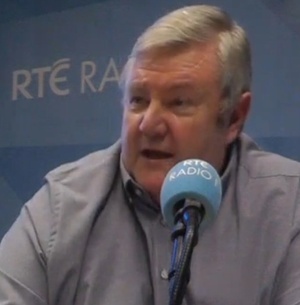



John Banville
Author John Banville, one of the signatories of an open letter last week from artists and academics and others decrying cancel culture, spoke to Brendan O’Connor on Saturday’s Weekend on One on RTÉ Radio One.
Brendan O’Connor: “There’s an important distinction to be made here. This letter is talking about people losing their livelihoods, this is not to suggest that people can’t be taken on, on their views, if their views are offensive or outdated, correct?”
John Banville: “Yes, of course. Of course they can be taken on. But part of the problem is that so many people in positions of power and publishing houses, in academia are losing their nerve and are getting rid of people on hearsay, on having made mistakes. Goodness sake, we all make mistakes. If we were to be driven out of our jobs because of making mistakes, we’d all be unemployed.”
O’Connor: “But I suppose that the people who are in favour of cancel culture and calling people out would argue this is about people who are powerless, unlike those powerful people in publishing, people who are powerless and that this is the only weapon they have to hit back at people who they would say are powerful and entitled and have platforms to spout these views.”
Banville: “The way to work for civil rights and for tolerance is to be kind and work…there’s a wonderful essay by John McWhorter, who just happens to be black, in an online magazine called Reason. He’s one of the signatories of this letter. And it’s [inaudible] because he’s saying, you know, this movement, especially among young white liberals in America has all the trappings of a cult, of religion and I think he’s right. And I’ll just quote a little bit from it, very, very short, I think it’s very apt. He says:
‘Martin Luther King was under no impression that all white people were going to fully “love” all black people. He spent his time working for gradual change in the world as we know it via endless exchange and consultation with the powers that be, not agitating for a vague utopian conception of a society devoid of any racist sentiment. In King’s day, radicalism was not centered around this recreationally aggrieved performance art, much less obsessively seeking to excoriate and destroy people suspected of impure thoughts.’
“It’s a wonderful quote and we should all think about that, that kind of sentiment.”
O’Connor: “Yeah, Margaret Atwood wrote that great essay, ‘Am I Bad Feminist‘. She talks in it about how writers deal in kind of moral ambiguity and everything and they will often have characters who aren’t nice people and who say bad things and everything but what she said in it, is that we’re at, this is a revolution and we are at, I think she called it, the purge and destroy part of the revolution. Words to that effect, that this is just about, that we’re taking people out now.”
Banville: “That probably is the case. But one must raise one’s voice against that kind of mob culture even a mob, you know, that is well meaning, is still a mob and to hound people…and, you know, I’ve been to America, I’ve seen instances of it myself. A friend of mine was an academic, almost lost a job because she suggested to a Chinese student, not a Chinese immigrant, but a Chinese-born student that he needed to work a bit on her (sic) basic English. The Chinese student complained and my friend was almost fired by her university. There are numerous instances of things like that.”
O’Connor: “Do you know writers who have had their work suppressed?”
Banville: “Yes, yes. I’m not going to name names that would be embarrassing but I do – suppressed by their, suppressed by their publishers. And that is very, very dangerous.”
O’Connor: “Yeah. You would regard yourself as a liberal obviously, you are a liberal and you’ve worked in America and everything and you would be very pro civil rights and everything, I know. What do you think of the character of the Black Lives Matter movement and how it’s playing out at the moment?”
Banville: “I think it will waken some people, it certainly brings our attention to the problem. But America is absolutely divided now. I mean it’s just divided down the middle. It’s back almost to civil war politics in America. It’s a frightening place to be at the moment. That is not going to be cured by ousting people from their jobs. There’s a wonderful phrase in French which says, you know, the extremes touch. In other words, you know a right and left meet at the back and become just a [inaudible] of each other and I think many ideas, from liberal young people, while they mean well, but they are falling into a religious cultism. And you know that’s all about making yourself feel better.
“Did you see that clip of Barack Obama talking about the woke movement and saying, you know, it’s so easy to point to people and say ‘you’re a sinner’. You know, you’re doing all these things wrong and I’m much better than you and then you go away feeling wonderful about yourself. This doesn’t do any good.”
O’Connor: “You say a lot of people now feel muzzled, that they’re worried about saying the wrong thing?”
Banville: “Certainly in America, that’s the case.”
O’Connor: “John, outside of cancel culture altogether, you have a book out in October?”
Banville: “I have but I can’t use this occasion to plug a book, this is much too serious
Listen back here
Previously: Hello, Yes, I’d Like To Cancel My Subscription To Harper’s