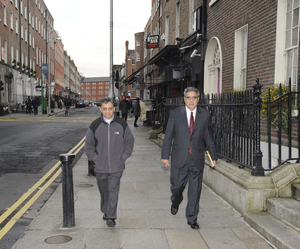
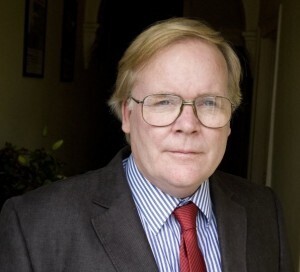
Clockwise from top left: Graham Norton, Ryan Tubridy, John Humphreys and Seán O’Rourke

‘eoin’ writes

In the UK (population 65m, 13x Ireland), the BBC publishes the list of staff paid £150,000+ (€168,000) a year in the year to April 2019 (that is, for a period which ended three months ago)….

John Humphrys, a titan of broadcasting whose daily 3-hour radio show gets around 5m listeners is paid £290,000 (€325,000)

In Ireland, Sean O’Rourke was paid €308,964 by loss-making RTE in the year to December 2016.

Meanwhile, Graham Norton only gets £610,000 while the mediocrity on the loss-making RTE Late Late Show gets €495,000 (excluding royalties on his book which exploits the Toy Show “jumper” thing)?

Also if the BBC can publish presenter salaries within 3 months of the year end, why does it take loss-making RTE 22 months?

Here’s the full list of BBC on-air stars earning over £150,000

BBC pay: Claudia Winkleman, Zoe Ball and Vanessa Feltz among top earners (BBC)

Related: Vanessa Foran: Reeling In The Year

‘sup?

This morning.

Blessington Street Park (The Basin), Phibsborough, Dublin 7.

A filthy, thieving pigeon gets too close to an Eurasian Coot and its egg-filled nest.

That’ll learn the pigeon.

Probably not.

Meanwhile…

This morning.

A Cormorant preens itself ahead of fishing in Blessington Street Park.

Lovely plumage, in fairness.

Sam Boal/Rollingnews

From top: Sunday’s Pride March in Dublin; A recent decision from an International Protection Officer at the Department of Justice in respect of a 19-year-old Muslim man seeking asylum in Ireland.

‘Overall, the applicant’s account of the discovery of his sexual orientation lacks detail and specificity of someone who is gay…’

Movement of Asylum Seekers in Ireland tweetz:

This (above) is a decision issued by an International Protection Officer in the Department of Justice on 14th June 2019. He’ll have to prove his sexual orientation when he appeals.

People were actually happy when the Department of Justice  put up rainbow flag & paid for asylum seekers to go to #Pride…

Previously: Misplaced Pride

The Lonely Battle of Thomas Reid.

The ‘immersive’ documentery by Berlin-based Irish filmmaker Feargal Ward made its television premiere last night on RTÉ One.

‘Robert D’ writes;

The best thing I’ve seen on RTÉ in about ten years….

Previously: Reid All About It

Meanwhile…

Pause.

FIGHT!

Cathedral Court, Dublin 8 (above) a development by Sherbourgh Enterprises owned by members of the O’Callaghan hotel family.

This morning.

The Irish Times revealed recently that Sherborough Enterprises, controlled by members of the family that owns the O’Callaghan hotel group, expects apartment owners at Cathedral Court in Dublin 8 to pay more than €5,000 each to repair building defects in an apartment block that it built and still partly owns.

Niamh Towey, in The Irish Times, reports:

The developer of a Dublin 8 apartment block with serious building defects has gained control of the board of the block’s owners’ management company (OMC).

…Three members of the O’Callaghan family – Noel, Paul and Charles O’Callaghan – are now on the board after a vote was held at an EGM last week.

Of the four private owners who put their names forward to join the board, two were elected.

Cearbhall Beggan, a private owner who had been on the board alongside Paul O’Callaghan for the last number of years, resigned in protest before the vote took place.

Developer gains control of board of defective Dublin 8 apartment block (Niamh Towey, The Irish Times)

Pic: Google Maps

The Sinn Féin motion suggested the Department for Infrastructure be brought to court over its refusal to remove paramilitary flags and banners from lamp posts.

It comes after UVF flags appeared in the Cantrell Close area where they have previously caused controversy.

Last month, the Ministry of Defence spoke out against the unofficial flying of Army flags and emblems, after a number of Parachute Regiment flags and banners were put up.

Unionists opposed the motion, but it passed backed by 34 councillors. Eighteen voted against it.

Anyone?

Belfast council pass paramilitary flags motion (BBC)

From top: Ajai Chopra (right), then Deputy Director of the International Monetary Fund (IMF) European Department, and an associate on their way to a meeting at the Department of Finance to discuss an EU/IMF emergency loan, November 2010; Michael Taft

Economic historians will write of the period we are just emerging from as the ‘lost decade’. When the crash hit, jobs were lost, incomes fell, and government spending was slashed.

It is only now – 10 years or so after the event – we have made up that last ground. Now we have low levels of unemployment, rising income and warnings that the government is increasing spending too fast.

But as we emerge from out of the shadow of the crash, what does the world around us look like?

Well, if Eurostat is anything to go by, we still lag other high-income EU countries in key living standard categories.

Living standards is notoriously difficult to measure. However, Eurostat makes a stab at it with their ‘actual individual consumption’ indicator.This combines personal consumption (consumer spending) and government spending on behalf of households.

This latter is important. If one just took consumer spending as the measure of living standards, a number of anomalies could arise.

For instance, if an Irish household spends €150 per week on childcare while a German household spends only €50, a consumer spending-only measurement would suggest the Irish household had a higher ‘living standard’.

However, under the actual individual consumption (AIC) measurement, the amount of state subsidy on childcare which the household ‘consumes’ is also factored in.

That makes it a superior measurement, especially as it factors in prices for international comparison purposes.

Under these living standard measurements – AIC and consumer spending – how do we fare in 2018?

Factoring in inflation we find:

Per capita consumer spending is still 2.1 percent below the peak in 2008

Per capita AIC is still 3.1 percent below the peak in 2009

Hopefully, this year will see us surpassing pre-crash peaks.

Except just as we are emerging from a lost decade we have warnings of over-heating in the economy.

Question: how could we get to a situation where, after a decade, all we do is return to the point at which we started and, yet, we’re in danger of over-heating?

Some might say that our previous peak was unsustainable. Without getting into that historical argument, this is hardly the explanation today.

Even if we concede the argument that consumer spending and AIC (which includes government spending on behalf of households) was unsustainable in 2008, that argument shouldn’t apply today.

Both consumer spending and AIC are significantly below 2008 levels as a percentage of GNI*; yet now we are being warned that we are at capacity (just like a decade ago).

So at this point of full capacity, how does Ireland fare compared to other high-income EU countries, our peer group?
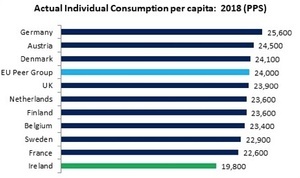
We are far below our peer group average in this living standard measurement. We would have to increase consumer and government spending on households by over 20 percent to reach the average.

When we disentangle consumer spending and government spending on households we find the gap remains somewhat the same.

Both consumer spending and government spending on households are well below our peer-group average, with Ireland coming in at the bottom of the table in both.

Consumer spending would have to increase by 16 percent and government spending on households would have to increase by 40 percent just to reach the average.

So after a lost decade, when we have only returned to pre-crash levels, when our living standards are still well below other high-income EU countries, we have hit a capacity wall suggests the problem is deeper than just fiscal policy (though that is a contributor). It suggests that there is a structural problem.

Now consider the impact of even a ‘managed Brexit’ (?) never mind a no-deal Brexit. We would not only stall, we could start falling backwards.

After a lost decade, we may still be lost.

Michael Taft is a researcher for SIPTU and author of the political economy blog, Notes on the Front. His column appears here every Tuesday.

Sam Boal/ Rollingnews

The vast expanse of sea ice around Antarctica has apparently suffered a “precipitous” fall since 2014

An orbital scanning device
That measures the Antarctic ice
Says that in recent years
Even more disappears
Than anyone could think is nice

John Moynes

Pic: Getty

Broadsheet.ie
