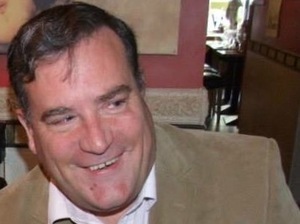
Artist Robert Ballagh

‘I was not at all surprised to read the open letter signed by more than 300 Irish practitioners that was sent to Minister for Culture Josepha Madigan expressing their deep concern and dissatisfaction with the direction that the Abbey Theatre has taken in recent times.

However, I was surprised that the letter did not raise an obvious question: why is the Irish National Theatre, which has an obligation to reflect Irish cultural values, currently being run by two Scotsman?

I suppose if this disconnect was simply a problem for the Abbey Theatre, the situation would not be so serious, but at this moment in time practically every national cultural institution is being managed by an outsider.

For example, the director of the National Gallery of Ireland is an Englishman, the new director of the Hunt Museum in Limerick is a Welshwoman, the director of the National College of Art and Design is an Englishman, and the director of the Gate Theatre is an Englishwoman.

It seems that when it comes to our cultural institutions that warning experienced by our emigrants in the past still holds sway: “No Irish need apply.”

Robert Ballagh,

Dublin 7

FIGHT!

Irish Times Letters

Yesterday: Shabbey

Rollingnews

Meanwhile…

Sarah Glennie?

Infographics of the EC’s findings on Ireland’s tax dealings with Apple (top) and (above) the EC’s investigation of Nike and the Netherlands

This morning.

Almost two and a half years on from the European Commission finding that Ireland gave illegal tax benefits, under EU state aid rules, to Apple worth up to €13billion…

The EU Commission has announced that it has started an investigation into Nike and the Netherlands – to see if the Netherlands has given Nike an unfair advantage over its competitors, in breach of EU state aid rules.

State aid: Commission opens in-depth investigation into tax treatment of Nike in the Netherlands (EU Commission)

Claire McGettrick tweetz:

A tiny sample of the pages which Tusla redacted in my adoption file before sending to me. I’m happily reunited with my mother for over 25 years, so who are they trying to ‘protect’ here? Adopted people are being left behind in so-called modern Ireland #EndSecrecyNow #Stand4Truth

Anyone?

Irish woman speaks to 7 News in Australia after the sighting of a Great White shark in Tamarama beach near Sydney, Australia.

‘It was a big one’: Four-metre shark spotted off Tamarama Beach (The Sydney Morning Herald)

H/T: Colette Browne

https://www.youtube.com/watch?v=W4gYNfJUj2k

An adorable 2019 Oscar nominated, short from Dreamworks TV wherein a small blue rodent attempts to protect himself and the fluffy bird he befriends from a cavalcade of predators in the Australian outback.

awesomer

Twenty years ago….

Rachel Carey writes:

January 15 marks the 20th anniversary of Pádraig Flynn’s memorable appearance on the Late Late Show.

During a routine interview with Gay Byrne, Pádraig Flynn, then EU Commissioner, was portraying himself as a perfect politician. When pushed to speak about Tom Gilmartin, a property developer who was reluctant to speak at the Mahon Tribunal, Flynn snapped.

He launched into a rant about Gilmartin and his wife, who suffered from multiple sclerosis and was paralysed in a wheelchair. Gilmartin who was listening to the interview at home in the UK vowed to bury Flynn.

It was an interview which would change the shape of Irish politics forever and cause the demise of Pádraig Flynn.

Jack Murray, CEO and founder of MediaHQ.com, wrote and recorded a podcast (above) vividly recounting the story of the interview.

The podcast really gets into the detail of the story and gives us some background that many people wouldn’t be aware of….

Media Moments

Previously: I Wanna Tell You Something, Try It Sometime

From top: Ballot papers from the European and Local Elections, May 24, 2014 at the count centre in the RDS, Dublin 4; Dan Boyle.

Since 1999 Local and European elections in Ireland have been held on the same day.

Returning officers at count centres have liberally interpreted our electoral laws, as many voters continue to mark one ballot paper 1,2,3 and 4 in expressing their preference; then marking the other paper 5,6,7 and 8, as if there is meant to be some symbiotic relationship between the two elections.

To some extent there is, if only through holding the two sets of elections on the same day. Both are mid term elections that each have the capacity of making life uncomfortable for the sitting party of government.

The local elections, however, operate to a different set of conditions. These elections are the most candidate centric of elections held in Ireland.

While fewer voters participate in local elections, as opposed to elections to the Dáil, those who do participate make greater demands of the candidates. The reality is that at what we have in Ireland is not local government, but a glorified form of local administration.

Despite this we place expectations on candidates, who seek to become local councillors, that can never be met through the structure local government in Ireland.

Ireland is one of the, if not the, most centralised countries in Europe in relation to local government. Many myths persist about the level of powers that exist, and on whether we involve too many elected people in our local councils.

Too many decisions are made at a national level that can, and should more properly be made, at a local level. Any of the changes that have occurred in Irish local government, over the past twenty years, have been negative. Powers have either been taken away from local councils, and more particularly from elected councillors.

The removal of town councils in 2014 by the Fine Gael/Labour government, pushed through by then Minister for the Environment, Phil Hogan, was probably the most undemocratic decision in the history of our State.

There has never been any sincere attempt to bring about democratic reform of local government. We have seen several attempts of deck chair rearranging.

These changes have been instigated largely at the behest of senior civil servants at the Department of the Environment/Local Government, who zealously guarded the administrative aspect of local government while keeping any hint of improving local democracy underfoot.

The wrong arm of local government was dismissed in 2014. We should have kept town councils, expanded their geographical boundaries and decision-making powers, so that they would become District Councils, based on natural hinterlands.

What we need to be rid of is the County system of government. The 1899 Act, passed in the Westminster parliament, remains the main basis for local government in Ireland. The other jurisdictions where this legislation also applied – England, Scotland, Wales, even Northern Ireland have long since jettisoned county government. We should too.

Because the GAA organises itself on an inter county basis, has meant there has been a reluctance to address this necessary change. English cricket still clings to the myth of now disappeared counties. There is no reason why the GAA can’t do the same.

What we should have is a layer of regional government where, under suitable economies of scale, and where appropriate powers have been devolved from national government (in areas such as health and education) better accountability and improved public participation can be achieved.

It would be nice if this were to form what gets debated during the local election campaign. I wouldn’t be holding my breath though.

Dan Boyle is a former Green Party TD and Senator. His column appears here every Thursday. Follow Dan on Twitter: @sendboyle

Rollingnews
The Chime radio telescope in Canada has detected 13 radio bursts

Astronomers picked up a trace
Of a signal from some far off place
This is no time for jokes
Let’s declare it a hoax
Before Trump wants a wall up in space

John Moynes

Pic: Chime Collaboration

Broadsheet.ie