This afternoon.

Leinster house, Kildare Street, Dublin 2

Protesters against corruption in Ireland, including Margaret Cash (pic 2) whose children slept in a garda station last month, greet politicians as they return from their summer holidays.

Earlier: They’re Back

Leah Farrell/RollingNews

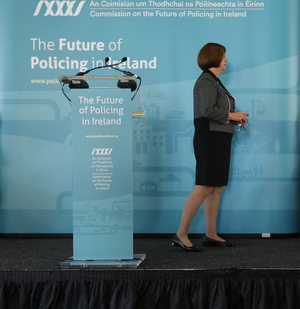
From top: The Commission on the Future of Policing in Ireland; Garda Inspectorate Kathleen O’Toole speaking at the publication of the commission’s report today; and the report

It’s so bright.

You may need a fire retardant mask.

This afternoon.

The Commission on the Future of Policing in Ireland has published its 128-page report – 16 months after the commission was established.

In a summary of its key recommendations, it states…

An Garda Síochána should have a human rights strategy, and a human rights unit within the organisation to develop, implement and monitor the strategy. It should work with the Irish Human Rights and Equality Commission to fulfil its human rights and equality responsibilities. Legislation defining police powers of arrest, search and detention should be codified, with statutory codes of practice.

…While crime is a top priority for police, in practice the majority of police time, in Ireland and elsewhere, is spent on harm prevention – providing service to people with mental health and addiction conditions, homeless people, children, elderly and others at risk. This broader concept of community safety needs to be embedded in legislation in a new Policing and Community Safety Act.

The Act should cover not only the police, but also the other agencies of government responsible for people at risk – including local authorities, health, child and other social services – who should be required by law to work with the police to protect people from harm.

…However, the national security function should not be lodged entirely within the police organisation and it is now necessary to augment An Garda Síochána’s responsibility for security operations. There should be a more structured multi-agency approach to security, and a Strategic Threat Analysis Centre, based in the Department of the Taoiseach and headed by a National Security Coordinator.

…An enhanced, regular programme of engagement between An Garda Síochána and the Joint Oireachtas Committee on Justice and Equality should be introduced to improve the effectiveness of this channel.

…The operational independence of the Garda Commissioner should be explicit in legislation. Oversight should be streamlined, more coherent and strengthened in a new Policing and Community Safety Oversight Commission (PCSOC), superseding the Garda Síochána Inspectorate and the Policing Authority, and taking on most of their functions as well as some new ones.

…The system for managing complaints should be overhauled. An independent body, superseding GSOC, should be established, perhaps named the Independent Office of the Police Ombudsman (IOPO) to make clear that it is not part of An Garda Síochána. IOPO should receive all complaints about the police service, from whatever source.

...The Commissioner should be supported in running the police organisation by a statutory Board. Rarely if ever does a career police officer reach the position of chief of police with the full range of knowledge and expertise to run a complex institution of 15,000 people and a €1.65 billion budget.

…Poor quality crime data hampers both investigation and prevention. New systems, new processes, and better training in how to use them, are essential. So too is an agile data analytics capability, able to assist police operations in real time.

…. More police working in and with the community will help prevent and detect crime, reduce fear of crime, and protect people at risk. Many police are now doing jobs that do not require police powers, and should be done by nonsworn employees or outsourced. Police also have unnecessary administration duties, such as keeping paper records, duplicating electronic ones. These should be stopped.

…The structure of An Garda Síochána should reflect the focus on the front line by becoming flatter and less siloed. Headquarters should set policies, broad strategy, standards and objectives.

…There was no recruitment and virtually no training for nearly six years following the financial crash. Now the pace of recruitment is very fast, putting strain on both the training college and the capacity of the organisation to absorb and supervise new recruits.

The great majority of recruits already have academic degrees and do not need some of the academic elements of the current recruit foundation course. Recruits who have degree qualifications prior to entry should therefore do a shorter course focused on policing, before moving on to their probationary Garda service in police stations, where, as we have said, supervision at sergeant level should be strengthened.

….A more determined effort should be made to recruit a more diverse workforce, both non-sworn and sworn, diverse not only in gender and ethnicity, but also in socioeconomic, educational and geographical background. A Garda Access Programme should be developed…

…An Garda Síochána needs to take better care of its employees. Policing presents both physical and mental challenges to wellbeing. The police urgently need a proactive programme to address wellness, with dedicated funding, as well as improved supports including timely debriefing and mandatory counselling after traumatic events.

…An Garda Síochána badly needs to introduce better business processes and systems for collecting, recording, managing, analysing and disseminating information about crimes, incidents, complaints, finance, human resources and other management issues…

…Technology can provide the tools for this, as part of a comprehensive strategy for digital innovation. Current Garda technology is outdated and inadequate, to the detriment of both effective delivery of police services and efficient allocation of resources. Data should be seen as a strategic asset and a key factor in determining policing decisions…

…. The culture should be one of a team of professionals working together, not a hierarchy in which foot soldiers wait for instructions from above.

…An Garda Síochána should work with the technology sector in Ireland and with academic expertise to support police in tackling cybercrime and other technologyenabled challenges.

A Digital Policing Innovation Centre, supported by Enterprise Ireland and IDA Ireland, would enable An Garda Síochána and Ireland as a whole to contribute to technological innovation in policing.

…The large reform programme we have proposed cannot be completed overnight, but it must be progressed as fast as possible and we believe that 2022 is a realistic target date for policing to be substantially transformed. It is also symbolically important as the year in which the 100th anniversary of the founding of a police service for the Irish State will be celebrated.

The report can be read in full here

Eamonn Farrell/Rollingnews

In Carlow.

Tully’s Bar tweetz:

We’re supporting Michael D Higgins are you? We got these deadly badges from @Merch_Addicts and we want to give them away.

The first people to come to the bar to show us the registration email from michaeldhiggins.ie will get a free badge (while stocks last)….

Previously: It Starts Here

Meanwhile…

‘sup?

Lois McGrath writes:

Macy (above) says keep the dog in the Park…


.

From top: Minister for Housing, planning and Local Government, Eoghan Murphy and Taoiseach Leo Varadkar at the launch of the establishment of the Land Development Agency last week; Dr Michael Byrne

With Sinn Féin submitting a motion of no confidence and widespread revulsion at the eviction of the Take Back the City occupation in Dublin 1, Minister for Housing Eoghan Murphy finds himself once again scrambling to defend the Government’s response to the homelessness crisis.

Under these circumstances one would assume the government would take every opportunity to stem the tide of homelessness.

One such opportunity is to address the danger posed by the huge number of Buy-to-Let properties in arrears. But as has been the case with each aspect of this housing crisis, the government seems bent on ignoring the issue until it is too late.

The eviction of tenants from the private rental sector is central to the homelessness crisis.

In response to last week’s news that the numbers in emergency accommodation had reached almost 10,000, Focus CEO Pat Dennigan pointed out that the main reason families are becoming homeless is because they are evicted from the private rental sector when the homes they are living in are sold or repossessed.

And if the summer is anything to go by, this problem is going to get considerably worse as Irish banks offload their non-performing Buy-to-Let mortgage books.

In May, AIB sold a €1.1 bn loan portfolio, which included Buy-to-Let mortgages. In July, Permanent TSB agreed the sale of 10,700 mortgages, of which approximately 3,300 were reported to be Buy-to-Let loans, to an affiliate of Lone Star Funds.

This summer also saw Ulster Bank announce the disposal of 2,900 Buy-to-Let mortgages, while KBC offloaded €1.9bn, including Buy-to-Let loans, to Goldman Sachs.

The push to off load non-performing Buy-to-Let loans is in part a response to direction from the Single Supervisory Mechanism, an ECB institution responsible for ensuring the ‘safeness and soundness of the European Banking System’.

The SSM want Irish banks to bring the proportion of NPLS down to approximately 5% (at the end of 2017 the NPL ratios was just under 14%). This is an important goal as high levels of NPLs make the Irish financial system vulnerable to future shocks.

However, with Irish lenders aiming to hit the 5% target over the next few years, it is clear that thousands of tenants will find the properties they call home in the hands of vulture funds.

This can only mean eviction, and the risk of homelessness.

When it comes to vulture funds, politicians have focused their attention for the most part on so called family homes being sold to international funds. This an important issue.

But Buy-to-Let properties are family homes too – it’s just that in this case the families in question are renters.

Moreover, the impact of homeowner mortgages being off loaded remains somewhat unclear. In the Buy-to-Let sector, however, repossession always means eviction.

What makes this a scandal, rather than simply cause for concern, is that many of these lenders are in part state owned and have received massive government support in recent years. PSTB is 75% state owned and AIB is 71%.

The state, in a sense, is creating the very problem it is struggling to contain.

The good news is that there are immediate solutions, although they require careful consideration.

In 2015 (even then it was obvious this was a disaster waiting to happen) I proposed a NAMA-type intervention focused on non-performing Buy-to-Let loans. This would acquire loans and use rental income to cover the costs, keeping tenants in their home.

Similarly, the Oireachtas Committee on Housing and Homelessness final report, published in 2016, recommended a ‘rent switch programme’ which would allow Housing Associations or Local Authorities to purchase rental properties from receivers or investors.

The same Committee also recommended the removal of ‘sale of property’ as grounds for terminating a tenancy, i.e. an eviction. Properties could still be sold, but without effecting the tenant.

Finally, a temporary moratorium on any evictions in the private rental sector could be introduced.

Some might say we should simply let the logic of the market play out, even if this means thousands of evictions, and that state intervention on this scale is unwarranted.

The reality, however, is that this is not the law of the market. Most of the institutions who are selling Buy-to-Let mortgages simply would not exist where it not for the largesse of the tax payer.

Bailing out lenders may have been justified to address the financial crisis. But on that basis, surely emergency measures are justified to address the current housing crisis?

Central Bank data for the first quarter of 2018 tells us that there are currently 22,545 Buy-to-Let mortgages in arrears (19% of the total). During this period, 314 such properties had receivers appointed to them – that’s more than three every single day.

This scale of this problem should be of clear concern. But whatever your view on how this issue should be tackled, what is most damning of all is the fact that there is no plan whatsoever.

Dr. Michael Byrne is a lecturer at the School of Social Policy, Social Work and Social Justice, UCD and participates in the Dublin Tenants Association.

Rollingnews

 

Fine Gael TD and Minister of State for Housing Damien English

“First of all, I want to say I wouldn’t excuse their [Take Back The City] behaviour to do with frustrations. I’m not sure what other proactive options those people involved in these protests have actually engaged in the system.

“There’s numerous ways, if they want to engage with local authorities to help us tackle vacancies but I’m afraid blaming frustrations on it, is not a good enough excuse in my view.

“Because I think their behaviour is disgraceful. I’ve no problem, if they want to highlight the issue. But what they’re doing is wrong, in my view, and it’s criminal activity and it’s wrong.”

Comments made by Fine Gael TD Damien English speaking this morning on RTÉ Radio One’s Today with Seán O’Rourke.

During the interview, Mr O’Rourke asked Mr English about his view of the Take Back The City action group and vacant housing in Dublin.

Fr Peter McVerry, of the Peter McVerry Trust, was also interviewed.

Fr McVerry said he can see the vacant housing occupation movement growing whereby up to 100 properties across the country may be occupied at once.

Listen to the interview in full here.

Previously: A Modest Vacant Housing Proposal

What’s Going On Here?

Rollingnews

Masked gardai assist the removal of protestors from North Frederick Street

Following on from Minister for Justice Charlie Flanagan telling Seán O’Rourke on RTÉ Radio One yesterday morning that he would support legislation to outlaw photographing on-duty gardai…

Aidan O’Brien, who filmed a Reclaim The Streets protest in Dublin in 2002, recalls…

Related: Garda who hit man’s head with baton is now an expert adviser on ethics (The Irish Sun)

Previously: Never Mind The Balaclavas

Nothing To Hear Here

Broadsheet.ie