


A multi-award winning short (and playable app) drawn by Michael Frei, coded by Mario von Rickenbach and pleasing to behold if you like your animations episodic and your identical characters tiny.



A multi-award winning short (and playable app) drawn by Michael Frei, coded by Mario von Rickenbach and pleasing to behold if you like your animations episodic and your identical characters tiny.
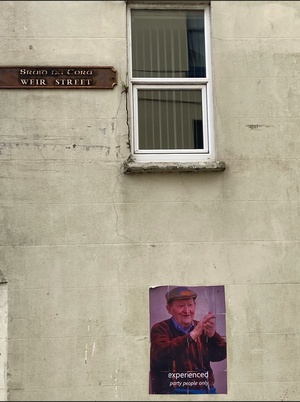

This afternoon.
Weir Street, Bandon, county cork.
Try the bandstand, kids.
Thanks Otis Blue


From top: Mother and Baby Homes Commission of Investigation in 2015, from left: Mary Daly, Yvonne Murphy and William Duncan, in 2015; Mary McAleese
“I think the Mother and Baby Commission of Investigation report is a magnificent work of scholarship, may I say. I think it’s a superb work of scholarship. It’s cool. It took 5 years. Cool though it is it replete with compassion…
…It is an extraordinarily important archive and I would like to congratulate the authors [Judge Yovonne Murphy, historian Professor Mary Daly and child law expert Dr William Duncan] who put five years of their lives into this. Let’s remember who they were.
Nobody knows more about this story, apart someone like the extraordinary heroine Catherine Corless and the women who suffered through their experiences in these institutions, there are probably few people in the world who know about this situation as these three people do and the team of people who work with them.
…You have to remember this is a report that is going to have to stand the test of scholarship, scholarly analysis, of profound research. These women have important stories to tell, every one of them has their own story to tell and I agree absolutely that it’s so important those stories are given absolute respect.
But then you take all the stories and you analyse them and you research them and you try to tell an overall narrative and as the report says from the very get-go, you’re dealing with complexities that are so profound that you are probably never going to be able to satisfy the hurt, the rawness, the woundedness, the need for vindication, the need for an apology, the desire for sorrow and the lives that can never be restored to them…
I was very impressed by the scholarship of the document and some people might think because it’s, you know, a bunch of lawyers and historians, they might find that, you know, the language of scholarship sometimes can appear, you know, not so much distant but objective but I do think there was huge, huge compassion.”
Former President Mary Mcaleese on RTÉ Radio One, January 16, 2020.
Yesterday, the Dâil heard that a new Mother and Baby Home Commission may have to be established after an admission that the report discussed above ignored hundreds of survivor accounts.
Yesterday: ‘Repudiate The Report’
Committee seeks to hear from mother-and-baby home commissioners (RTÉ)

Ugly Beautiful – Sunrise
A ray of light.
Irish alt.rock trio Ugly Beautiful specialise in shimmering guitars and introspective themes.
The band comprise of Kieran Lane (top left on lead vocals and guitar), Falender (drums) and Galagher (bass).
Kieran writes:
“The song tells the story of two people trying to help each other through this relentless, confusing, distracting world in which we live.”
The video animation by Aaron Wiley is a work of art in itself.
Nick says: Lane sailing.

Killiney Hill, county Dublin
Meanwhile…

Great Killiney Hill illustration on the side of a gaff in Dalkey 😍 pic.twitter.com/NX0C1IRxWK
— Ed Fidgeon-Kavanagh (@Clearpreso) June 3, 2021
This morning.
Dalkey, county Dublin.


Behold: Velox – a prototype amphibious robot designed by Pliant Energy Systems of Brooklyn with an all terrain propulsion system inspired by the locomotion of several natural species. To wit:
Velox can use several modes of locomotion found in the animal kingdom using just one pair of “fins”. These fins are best described as four-dimensional objects with a hyperbolic geometry that allows the robot to swim like a ray, crawl like a millipede, jet like a squid, and slide like a snake.
A craft equipped with this system has unprecedented freedom to travel through a range of environments in a single mission. As an underwater vehicle, the robot’s ability to instantly reverse direction and do quick turns make it ideal for task such as coral reef inspection or dragon fish hunting where a craft must rapidly manoeuvre to look around and between objects.
First the dragon fish, then all humans.


The Art Deco Chancery Street House flats and park in Dublin 1
Chancery House and Park.
Harry writes:
Dublin has some wonderful little parks tucked away but this tiny Art Deco-style Park is hiding in plain sight, it is located just off the quays beside the Four Courts. Attached to the Art Deco style Chancery Street House flats or in today’s parlance, apartment block, Chancery Park may be a small park but it has a beautifully cultivated garden with a stylised fountain, a pool and formal yew topiary plants.
Make sure you check out the front of the kiosk in the park, it has delightfully designed geometric railings and an ornate clock all in a wonderful Art-Deco style. Credit where credit is due, the park is well kept and clean, the local residents are proud of it and it is a fine example of the work done by the Parks & Landscape Services of Dublin City council.
But where did Dublin get this Art Deco Park from? In the 1930s, at a time when Dublin was notorious for its tenement slums and the State barely had two halfpennies to rub together, an incoming Fianna Fáil government put an emphasis on tenement slum clearance and new housing in its election campaign. After the election the political will was evident with housing acts being passed focusing on slum clearance and funding was found for the large-scale construction of social housing by local authorities.
Come the time and come the man. Herbert Simms was a Londoner and a veteran of the First World War. After his military service Simms won a scholarship and studied architecture at Liverpool University. After graduation he came to Ireland joining Dublin Corporation in 1925 in a temporary role as architect to Dublin Corporation until 1927. From the beginning of his employment with Dublin Corporation his concern was in working class housing and in 1926 he visited Manchester, Liverpool and London to explore the latest concepts in flat construction. After a stint in Dublin Corporation Simms worked as a town planner in India for some time and he later returned to Dublin
In 1932 Dublin Corporation created a separate housing architect’s department to focus on the building of new houses and Simms was appointed to the new role of Corporation housing architect. He endeavoured to bring the best modern methods and ideas from the UK and Holland for public housing. He set about the task with great drive and ambition, immediately recruiting additional staff to work in the department.
In the sixteen years he was in the post and working on a fraction of the budget that similar sized European cities could secure, he was responsible for the construction of 17,000 flats and houses across Dublin. Simms championed good quality public housing in the city, drawing his influences from new apartment blocks designed by de Klerk in Amsterdam and J.P. Oud in Rotterdam resulting in his Art-Deco style designs in Chancery Street House and Henrietta House. Simms was also responsible for suburban housing estates in Crumlin, Kimmage and Cabra.
By all accounts Simms had put a tremendous personal effort into his heavy work load and being overwhelmed with work pressure he tragically took his own life by throwing himself into the front of a train near Coal Quay Bridge near Dun Laoghaire. He left a note mentioning that he felt his sanity threatened from overwork. He is now at rest in Deansgrange cemetery.
An article by F.N. Taylor, the city surveyor, printed in the Irish Builder in tribute to Simms said: –
‘Behind a quiet and unassuming manner there lurked a forceful personality; and Mr Simms could uphold his point of view with a vigour that sometimes surprised those who did not know him well. By sheer hard work and conscientious devotion to duty, he has made a personal contribution towards the solution of Dublin’s housing problem, probably unequaled by anyone in our time…It is not given to many of us to achieve so much in the space of a short lifetime for the benefit of our fellow men.’
So, if you find yourself in Chancery Park spare a kind thought for Herbert Simms, the driving force behind a large-scale programme of housing construction, a true public servant, city architect and champion of good quality public housing in Dublin.
Harry’s Dublin appears here every Friday.
Pics by Harry Warren


