


A day full of socially awkward moments (created when the world was still a relatively normal place) by Ukranian animator Nata Metlukh.



A day full of socially awkward moments (created when the world was still a relatively normal place) by Ukranian animator Nata Metlukh.


This afternoon.
Leinster House, Dublin 2.
A small ‘Get The Government Out’ protest outside the Dáil, calling for the current Government to be removed from power for its handling of the rona, along with an end to the homelessness crisis.
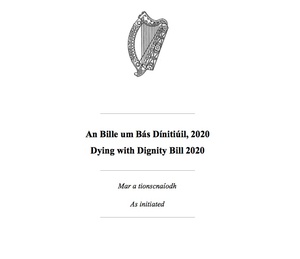
From top: The Dying With Dignity Bill 2020 Irish Palliative Medicine Consultants’ Association (IPMCA)
Tomorrow
The Dying with Dignity Bill 2020, which proposes making provision for ‘assistance in achieving a dignified and peaceful end of life to qualifying persons’, will be voted on in the Dáil.
The Private Members’ Bill, tabled by Gino Kenny, sponsored by Bríd Smith, Paul Murphy; Mick Barry and Richard Boyd Barrett, is being considered by Sinn Fein, The Green Party and supported by the Labour Party. The bill can be read in full here.
It is expected that the government will table an amendment to the bill that would hold it up for a year and require a special Oireachtas committee to examine the issue of assisted dying.
This morning, 17 members of the Irish Palliative Medicine Consultants’ Association (IPMCA) expressed their objection in a letter to The Irish Times:
As individuals and members of the Irish Palliative Medicine Consultants’ Association (IPMCA), we are gravely concerned by any proposal to legislate for assisted suicide and euthanasia in Ireland.
Based on our collective experience over many decades of providing specialist care to thousands of individuals in Ireland and their families each year, we have closely observed the experiences of people who have lived and are living with serious illness.
The threats of the proposed Bill to healthcare in Ireland, to the true meaning of the doctor-patient relationship and to the future of what we know compassionate and supportive specialist palliative care to be are many.
We worry about the impact on people who already struggle to have their voices heard in our society – older adults, the disabled, those with mental illness and others. We worry that the most vulnerable are those who may be made to feel a burden to their families and come under pressure to end their lives prematurely.
Our experiences tell us that many in our society don’t really know what dying is like, or how rare it is that severe pain cannot be controlled. Most people do not see that within the easing of physical, psychological or spiritual distress and addressing people’s fears, hopes, sadness and loss, the goal of palliative care remains to enhance the living of each life which often transforms the experiences of living, dying and bereavement for individual patients and their families.
We are convinced that as dying with dignity is already present within healthcare in Ireland, no change to our current laws is required.
Palliative medicine and dying with dignity (Irish Times Letters)


“I was reliably informed that Deputy Healy-Rae approached people outside a mass to say I can get you on the bus if you want a cataract [procedure]”
“You should take that back! You’re a disgrace!”@MichealMartinTD and @MHealyRae clash in the Dáil
More: https://t.co/TwPYcj6gS7 pic.twitter.com/hEirzW77Fb
— RTÉ News (@rtenews) October 6, 2020
This afternoon.
Dáil Eireann, Dublin 2.
“You need to relax, you need to relax a bit now…Deputy Healy Rae, Deputy Healy Rae, through the chair, all I remember, I was reliably informed that, through the chair, Deputy Healy Rae approached people outside of Mass, to say ‘I can get you on the bus if you want a cataract’.”
Taoiseach Michael Martin
“You should take that back, you’re a disgrace. You’re only the bottom of the barrel now coming out with that sort of a statement. And cop on a small bit Taoiseach.”
Independent Kerry TD Michael Healy Rae in response.
The Taoiseach tangles with Independent TDs Michael Healy Rae and Michael Collins, who had just revealed that he and Deputy Danny Healy-Rae have organised 2000 people (with some into their 90s) from all over Cork and Kerry to go to Belfast (over the past two years) to get cataract treatment.
Even a patient forwarded by Mr Martin’s own constituency office.
Previously: Our Cap Overfloweth


 From top: George Gibney; BBC Sounds/Second Captains podcast ‘Where Is George Gibney?’; Irvin Muchnick
I don’t expect to be named Miss Congeniality for having to break the news to folks in Ireland that the BBC/Second Captains podcast Where Is George Gibney?, despite being hyped to the heavens by the herd of independent minds in the Anglo-Irish media, is pitifully exploitative and faux-earnest, and that its practitioners are callow.
In the just-aired episode about Gibney’s rape of a 17-year-old Irish swimmer, pseudonymously called “Susan,” on a 1991 training trip in Tampa, Florida, producer-narrator Mark Horgan tracks down her sister for the purpose of, among other things, sharing with the audience the indispensable factoids that this sexual assault victim boasted a perfect breaststroke kick and the physical beauty of a model.
Not noted is that the victim herself was interviewed in explicit detail on RTÉ television back in 2006.
Generally, the new podcast seems happy to make fair use of archival audio — but only when the content in question conveniently aligns with the new project’s template of rewriting, and adding slick production values to, what was already reported and re-reported, even in the Irish media. The priority is a patina of freshness and exclusivity.
Meanwhile, Horgan devotes exactly one sentence to recording the rejection of criminal charges against Gibney by Ireland’s director of public prosecutions. The DPP, Horgan glibly avers, “did not have jurisdiction” over Susan’s rape.
Bullshit.
In fact, Susan was one of four former swimmers of Gibney’s Trojans team who lodged abuse allegations against the two-time Irish Olympic coach, prompting a fresh investigation by gardai in Blackrock, County Dublin.
In declining to pursue his extradition, the DPP office decided they were unmoved by the body of new evidence against him. As noted in my last article, this was in 1996.
And if jurisdiction was the sticking point in justice for Susan, then how, pray tell, does that square with the DPP’s revisiting her case yet again in 2004 (with the same result)?
The sad bottom line of this podcast series has become clearer and clearer:
The Horgan crew appeared to have no desire to use their BBC platform to assist in a global reckoning for the abuses of an Olympic sports system that turns millions of kids in extracurricular activities into vessels of our bread-and-circuses fantasies, while covering up the worst outcomes, many of them heinous.
In the interview of Susan’s sister, she betrays this superficiality. The tragedy of her sibling’s ruined life is, yes of course, that Susan, following multiple suicide attempts, would turn into a mental patient who required institutionalisation. But the other tragedy is the one about how the evil coach dashed a family’s dreams of Olympic glory — Susan’s, directly, and their parents’, vicariously.
Thus does our world devolve into full-tilt jockocracy, a place where the ultimate grievance is the one expressed by the Marlon Brando character in On the Waterfront: “I could have been a contender. I could have been somebody.”
For me, the derivative and thoroughly sophomoric nature of Where Is George Gibney? was evident from the first second of the first episode.
In that moment, Horgan and his cohort set off on a purportedly breathless, carefully engineered stakeout of an old man. Actually, Gibney was long known to be playing out the end of his miserable life in a house on Breakwater Drive in Altamonte Springs, Florida. Whether there is an actual punchline for this extended contrivance remains to be heard.
For the latest episode, Ireland’s answers to the Hardy Boys of children’s mystery books tell podcast listeners that they have changed pursuit cars for their undercover op.
Subscribing to the Michael Moore school of documentary making, Horgan must convey everything through his own eyes. Unfortunately, he lacks Moore’s wit and sense of purpose.
One of my Irish-American readers got it right.
Where Is George Gibney?, this reader wrote me early on, is “like an Australian one, The Teacher’s Pet, which turned a sordid but potentially interesting story into an irritating endurance test. My wife has difficulty listening to any Australian accents as a result.”
Irvin Muchnick writes at Concussion.net
Previously: Gibney Didn’t Vanish
Previously: The Chief Justice, Her Brother And How George Gibney Got Away
Meanwhile…
 Tonight.
Journalist Irvin Muchnick (above) will Answer A Broadsheet Reader.
Please leave any questions on Gibney, the BBC Sounds/Second Captains podcast or any other matters for Irvin below.
UPDATE: Irvin answers
Previously: Answer A broadsheet Reader on Broadsheet

St Stephen’s Green Dublin today.
Other water fowl friendly urban parks are available.
(Thanks Colum Cronin)

Charlie McGettigan – Ordinary Boy
Family matters.
Ireland’s erstwhile Eurovision hero Charlie McGettigan pens an uplifting ode to his grandson (top) that will put a smile on your face.
His new album Tuesdays With Paul is out now.
Nick says: Boy wonder.

Seems the Supreme Court judges have decided to socially distance themselves from Seamus Woulfe, at least on their website, putting a wee gap between the pre-existing judges and the newbie.https://t.co/YtAlQJP3fM pic.twitter.com/bwzxi4njOU
— nwl (@nwl88444048) October 6, 2020
Oh.
Meanwhile…
Some legal commentators believe Mr Justice Woulfe would be entitled at this stage to tell the Supreme Court he has co-operated with the non-statutory inquiry set up by them and has been vindicated by it.
It is difficult to see how he could be persuaded or legally forced to enter into a resolution process that has no firm legal basis.
Senior judges meet Woulfe, but no resolution yet (RTÉ)
Yesterday: Derek Mooney: Less Justice, More Just Us

This morning.
UK’s Talk Radio.
Chronic disease specialist and Covid response critic, Dubliner Ivor Cummins aka The Fat Emperor discusses the new rona data, false positives and ineffective lockdowns with Julia Hartley Brewer.
Previously: Ivor Lot of Questions
Meanwhile…
Justice Minister @HMcEntee says if level three or four is implemented she would like to see movement outside people’s county become a “penal offence” @RTENewsAtOne
— Fran McNulty (@franmcnulty) October 6, 2020
Yikes.
Meanwhile…
So what will change for people in Dublin, who have already been living in Level 3 restrictions?
Here’s what Commissioner Drew Harris had to say: pic.twitter.com/a389IpLqH5
— Hannah Murphy🎙 (@Hanelizaa) October 6, 2020
“This a mobilisation of the organisation”.
Um.
