

The spirit of “The Road Not Taken” (1916) by Robert Frost pleasingly animated by Ellen Su and Amy Xu of NYC based Aardman Nathan Love.



The spirit of “The Road Not Taken” (1916) by Robert Frost pleasingly animated by Ellen Su and Amy Xu of NYC based Aardman Nathan Love.

Secretary General of the Department of Public Expenditure Robert Watt
🚨 The Oireachtas finance committee has cancelled today’s meeting into the National Broadband Plan, after Dept of Public Expenditure sec-gen Robert Watt declined to attend… He says ministers and officials have attended already, and he’s going to the Comms committee next week
— Gavan Reilly (@gavreilly) June 18, 2019
… though I hear that, at the same time the Finance committee WOULD have been hearing from him in public session, Watt is also attending the Oireachtas Communications committee in private session!…
— Gavan Reilly (@gavreilly) June 18, 2019
Secretary General at the Department of Robert Watt previously called for the procurement process into the National Broadband Plan to be cancelled.
Despite his warning, Minister for Finance Paschal Donohoe signed off on it.
Meanwhile…
Yesterday…
Also looking forward to Robert Watt’s appearance in front of the Joint Committee on Finance, Public Expenditure and Reform tomorrow afternoon and whether he will reveal any of his “career ending” views on the National Broadband Plan 👀
— Donal Palcic (@DonalPalcic) June 17, 2019
Hmmm.
Previously: ‘A Harvey Smith To The Committee’


From a report by University College Dublin Geography Associate Professor Gerald Mills
Associate Professor at University College Dublin’s geography department Gerald Mills has found there are more than 4,700 trees growing within a 20m wide corridor along the 16 bus routes earmarked for possible road-widening as part of the BusConnects project.
The project aims to deliver 230kms of dedicated bus lanes and 200kms of cycle tracks along 16 of the busiest roads in Dublin.
A synopsis….
Thousands of trees may face the chop to accommodate BusConnects routes (UCD)


From top: Ruth Morrissey, barrister Aisling Mulligan
This morning.
On RTÉ’s Morning Ireland with Audrey Carville.
Barrister Aisling Mulligan, who specialises in medical cases, spoke to Ms Carville about the State Claims Agency’s appeal in relation to the High Court case of Ruth Morrissey.
Ruth and her husband Paul Morrissey were awarded €2.1million damages last month over the misreading of smear tests and the failure to tell her about it.
Ms Morrissey claimed that if her smear tests in 2009 and 2012 had been correctly reported, she could have been successfully treated and not developed terminal cancer.
When the judgment was granted, Judge Kevin Cross said Ms Morrissey’s life had been ruined.
He also said that medical laboratory screeners should have “absolute confidence” that there are no abnormalities in a test slide before giving a test the all-clear.
The term “absolute confidence” was also used by Mr Justice John Peppet in an English Court of Appeal judgment called Penney Palmer & Canon in 1999.
The State Claims Agency has said it is appealing the judgment and focussing on “a number of important legal points that may have significant implications for the State” but not the award of €2.1million to the couple.
On Morning Ireland, Ms Mulligan told Ms Carville that Judge Cross’s judgment contains almost 200 paragraphs and is an extremely detailed judgment.
She pointed out that, in paragraph of 15 of the judgment, he says that no testing is infallible.
Ms Mulligan said:
“He goes on to use the really practical example that we found in Mrs Morrissey’s case where, in 2014, she was diagnosed with cancer while receiving treatment but actually one of her screenings came back as negative.
“So that’s one of the practical examples that nobody asserted that there was negligence even though there was an outcome that was in fact incorrect.
“And that’s a really important thing for the general public to realise, that while the sentence ‘absolute confidence’ seems to be causing people an awful lot of concern; that this is going to close off the concept of cervical screening and, indeed, other screening.
“It’s very clear that, within the judgment and within the case itself, that there was an acknowledgement that there is always an aspect of limitation from the use of cervical screening.”
Ms Mulligan went on to say:
“The test of ‘absolute confidence’ is I suppose it finds its basis in Penney, in theory, but in reality what Judge Cross has identified in his judgment is: what do the medical practitioners set as their test for their standard of care?
“And it appears to me, at least, having looked at what he has determined as facts, is that there were five different witnesses who accepted that absolute [confidence] was the test that the medical professionals…was what was required of the appropriately qualified medical practitioner.
“And what follows from that argument is that it’s not absolute confidence that you do have cancer, it is absolute confidence that, if there is something on the screen, that it’s followed up on, that it is escalated.
“And that is the extent to which the test applies.
“….so if there is a grey area, if there is room for uncertainty, the question that the reasonable practitioner has to ask themselves is: am I certain that there’s nothing there?
“If the answer to that is ‘no’, I should refer on.”
Ms Carville asked Ms Mulligan if screening suffered as a consequence of the Penney judgment in the UK.
She said:
“I’m a lawyer and I’m not a healthcare expert so I would be careful not to draw, not to extrapolate too much but one of the comments that has been identified is that there were different problems in Penney and I think that’s probably true.
“There was a different factual nexus in Penney to what we have in Mrs Morrissey’s case. The relevance of that, I suppose, is whether or not it closed off screening in the UK.
“Respectfully, it hasn’t, the result hasn’t occurred.
“Whether it will happen here is a question that will have to be seen in reality.
“But the purpose of this judgment is to reinforce…the certainty that people have in cervical screening.”
In reference to the State Claims Agency that the appeal won’t affect Ms Morrissey’s award of €2.1million, Ms Mulligan said she’s not sure if the sum can be ringfenced before adding:
“There have been circumstances where appeals have gone over to superior courts on technical points after the other side have been, after the applicant, who has won their case, has been allowed to continue.
“I’ve not seen it on a financial basis. So it depends on two-fold: what are the State appealing, which we’re not clear on at this stage.
“What are the second and third defendants [two labs] appealing, which we’re not clear on, at this stage.
“And then the second question is: what will Mrs Morrissey’s position be.
“If the State were to indemnify, for example, Mrs Morrissey, that may result in a different, it may make it easier for the case to go forward on, I suppose, a point of public importance.
“But I have seen examples of where it has happened but not one where the issue of quantum or the issue of payout or compensation or financial settlement has been determined.
“I’m not familiar with one so we’re sort of in uncharted territory respectfully.”
Listen back in full here
Yesterday: State Appeal


From top: Bill Clinton’s portrait; from left Denis O’Brien, artist Colin Davidson and Mr Clinton at its unveiling yesterday
As does the nose strangely.
Yesterday.
Clinton Foundation HQ, Manhattan, New York.
Standing beside the painting, Bill Clinton said: “This actually captures a part of my personality I often try to keep hidden because I try always to be upbeat, I always try to be positive I always to think that the best is around the corner.”
…Irish businessman Denis O’Brien was among the guests at the function and he was thanked for supporting the role of the Clinton Foundation in a number of countries.
FBI Agents (out of picture).
Clinton moved by a ‘very Irish portrait’ Tommie Gorman, RTÉ)
Previously: Shaky Foundation
Pics: RTE

Michel Platini (left) and John Delaney at the Aviva in 2015
Of all those that have been either arrested, indicted etc., Michel Platini is the saddest and most depressing: he was a footballer, one of us. https://t.co/We7hUkY146
— Gary Lineker (@GaryLineker) June 18, 2019
Platini arrested amid probe into awarding of 2022 World Cup to Qatar (RTÉ)
Previously: Delaney Backs Platini To Succeed Blatter
Pic Uefa
Last month I was 26 years reunited with my natural mother, who is fully supportive of me getting everything on my file. Yet there are dozens of redacted pages. So I repeat, who is the State trying to ‘protect’? #AdoptionBill #KillTheBill #Stand4Truth https://t.co/J9SJDF9n4j
— Claire McGettrick (@cmcgettrick) June 17, 2019
Anyone?
Last week: Conflating And Confusing privacy And Secrecy

That scene in ‘Jurassic Park’ only with Pee Wee Herman rotoscoped into the shot instead of the T-Rex.
Because that’s 30 seconds well spent.
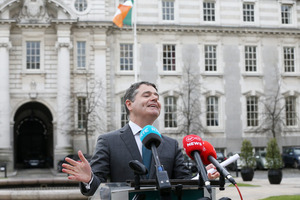

From top: Minister for Finance Paschal Donohoe; Michael Taft
The Minister for Finance believes in the property tax and the ‘latent potential for the tax to play a more significant and positive role in our overall taxation system’.
Any increase in the tax should be ‘affordable’ says the Minister, while the ‘progressivity’ of the tax should be upheld. Potential, affordable and progressive: yes, the Minister is a believer.
But a true believer would promote a full property tax – one that attaches itself to all assets, in particular those assets (such as financial property) that are held mostly by higher income groups.
The residential property tax is levied only on some property. It is confined to houses and apartments which are the main capital asset for low-average earners.
It is not applied to financial property (shares, bonds, pension funds, cash) or land beyond the one acre associated with the residential dwelling. This is a major omission.
If we put together real (land and buildings) and financial property, and exclude liabilities (e.g. mortgages), we find that total net assets come to approximately €750 billion following the red line in the following graph comes from the Central Bank.

This equals €156,600 average net wealth per capita or roughly €440,000 per household. This would be concentrated among higher income groups.
So what would happen if we started to refocus our tax system away from income and the productive economy and on to wealth, assets and property?
As the Nevin Economic Research Institute states:
‘The weight of evidence suggests that taxes on property, wealth and passive income have minimal negative consequences for economic growth compared to other taxes and are highly redistributive. Recurrent taxes on land and immovable property appear to be particularly pro-growth, and very likely pro-equality, and we can design these taxes in such a way as to make them progressive.’
We could start by extending the tax to all property with appropriate reliefs where necessary.
This is traditionally called a wealth tax but, in truth, it is merely ensuring a property tax is applied to all property; in particular financial assets.
The CSO’s Household Finance and Consumption Survey can help.
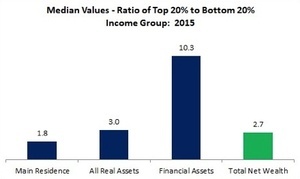
When we look at the ratio of asset values between the top and bottom 20 percent income groups, we find that for the main residence (home), the ratio is rather narrow due to widespread home ownership.
However, when we include all real assets (land, other real estate property, self-employment business wealth, vehicles and valuables), the inequality gap starts to widen with the top 20 percent owning three times the median value of the bottom 20 percent.
When it comes to financial assets, the top 20 percent own 10 times the value of the bottom 20 percent. Financial property is highly concentrated at the top.
Martina Lawless and Donal Lynch of the ESRI have produced a useful paper outlining the impact of an asset or wealth tax. They looked at nine different tax models applying a 1 percent tax on wealth.

We can see the range of models from those with high thresholds (income) and high exemptions (particular assets) to those with much lower thresholds and exemptions.
These models have the capacity to raise between €53 million and €3.8 billion. The variations are due to exemptions and thresholds. We should start a national conversation over the optimal model.
From NERI, Dr. Tom McDonnell’s seminal work on a net assets tax shows similar yields – ranging from €250 and €750 million in revenue (and this was published in 2013).
Of course, there will be the usual criticisms of a comprehensive net assets tax; namely, that it would disrupt our collective entrepreneurial chi. However, as Martin Sandbu from The Financial Times points out:
‘Compared with taxes on profits, dividends and capital gains, the wealth tax favours those who deploy their assets more productively. That is because it is a levy on the same slice of a fortune regardless of the returns the assets produce. Owners of a high-return asset . . . keep a larger share of the income generated by their wealth than owners of low-return assets . . . a net wealth tax effectively redistributes from those who invest their capital badly to those who find high-return uses for it. That should reward talented entrepreneurs and boost productivity growth in the economy overall — a combination that could just begin to look politically attractive.’
Extending the property tax to all property – making it a comprehensive tax on all assets – has the potential to make a positive impact on public finances, reduce inequality and extend the tax base.
This would vindicate the Minister’s belief in a property tax with potential, affordability and progressivity.
Indeed, it would make him a true believer.
Michael Taft is a researcher for SIPTU and author of the political economy blog, Notes on the Front. His column appears here every Tuesday.


You can keep yer oul’ pyramids because, since 2016, Japanese tea company Ocean Tea Bags has been producing a vast menagerie of teabags shaped like animals: from otters and red pandas to cephalopods.
The company recently started accepting orders from overseas and you can buy the full range of flavours here.