The Mummies of St. Michan’s Crypt.
There are many cultures around the world known for the preservation of the dead through mummification.
The most well-known are the Egyptians who preserved soft tissues by a deliberate action of embalming, preparing a body, they left the heart in place due to their spiritual beliefs, removed the rest of the internal organs, rinsed the body with wine, covered and packed the body with natron, a natural salt, leaving it to dry out for 40 days. The now shrivelled body was then plumped up with padding and perfumed, finally coated in hot resin and wrapped in a football fields length of linen strips.
The National Museum of Ireland in Dublin’s Kildare Street. has a petite but very interesting Egyptian room well worth a visit, with several mummies on view, including the mummy and coffin of the lady Tentdinebu dating from the first millennium.
Arguably the earliest practitioners of mummification occurred in what is now the north coast of Chile by the Chincheros, they mummified their dead as early as 5000 B.C. They also eviscerated the internal organs, treating them with salt and clay before returning them to the body. The dry arid climate did the rest for preservation.
Surprisingly, here in Dublin we have an excellent example of natural mummification and the macabre preserved remains can be viewed in St. Michan’s church vaults in Church Street, Dublin. Both the church and its burial vaults have a history to be told.
St. Michan’s is the oldest church on the north side of Dublin. Originally a Catholic Church founded by the Danes in 1095, it has been a Protestant Church since the Reformation. St. Michan’s has been renovated twice over the centuries, in 1685 and 1825. Its current incarnation is little changed since Victorian times.
The church itself is well worth viewing, it features an original wooden interior and a 1725 pipe organ with an original casing that is the oldest in Ireland. Reputedly it was on this organ that the composer Handel on a visit to Dublin first played The Messiah. There are some other unusual items displayed inside the church including a Stool of Repentance, where ‘open and notoriously naughty livers’ did public penance and a skull that purports to represent Oliver Cromwell.
It is what lies beneath the church in the crypt that is of most interest.
Inside the crypt the vaults contain the remains of some of Dublin’s most influential 17th, 18th and 19th century families.
There are participants of the 1798 rebellion, the Sheares brothers, who met a gruesome end, they were executed by being partially hanged then drawn and quartered. What was left of them was brought to St. Michan’s. The mathematician William Rowan Hamilton rests here along with the Earls of Kenmare and there are highly decorated decaying coffins of the Earl’s of Leitrim on display. In the church graveyard are other notables, including Oliver Bond, who took part in the 1798 Rising.
But the most unusual remains are the mummified bodies on view.
Since Victorian times many visitors have descended the steps of the crypt to view the bodies. If you visit you will be in the footsteps of the author of Dracula, Bram Stoker. He may have gained inspiration for his masterpiece as he is believed to have visited the vaults in the company of his family.
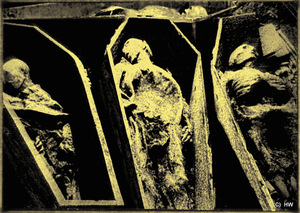
The last time I visited in pre pandemic times, there were four dusty mummified bodies, in decayed open coffins to view. Their skin turned to a leather like parchment stretched across their skeleton. Some dried out internal organs could be viewed where the abdominal area had split on one of the bodies.
The legend is that these four comprised of, “The Unknown”, “The Thief”, “The Nun” and “The Crusader” dating from 800 years ago.
The “Unknown” is a female of which perhaps unsurprisingly, there is no information.”The Thief” has had his hands amputated, supposedly as a punishment for his robberies. There was a body of a “Nun” and most famously there was a body of a “Crusader” who because of his tall stature had his legs broken and crossed under him in order to fit into his coffin. Legend has it that if you stroke his leathery hand, it will bring you good luck. I did stroke his hand and it had a texture like polished leather but about the good luck, no lottery wins but happily I can’t complain.
These bodies have been preserved in the crypt of St Michan’s Church for centuries. The church was built in close proximity to what was then Oxmantown marsh, gases from the marsh, mainly methane coupled with the limestone brickwork of the vaults along with a dry atmosphere and an ambient temperature that rarely varies from 14 degrees has resulted in the remarkable preservation of the bodies.
There is some conjecture as to the actual age of the bodies on display with some arguing that they “only” date from the 17th century. But if they are of more recent vintage, they are still remarkably well preserved as normal bodily remains would have been reduced to skeletons or dust by now. Marshes and bogs are excellent at preserving bodies.
Very sadly in 2019 the crypt was broken into and desecrated. The body of the “Nun” was severely damaged and is now no longer on display. The “Crusader’s” head was torn off, stolen and was missing for some time. Outside of the vault in a normal atmosphere it was feared the remains would rapidly deteriorate. Fortunately, with local input and good investigative work by the Gardai it eventually led to the recovery of the “Crusader’s” head. After restoration work by the National Museum, it is now reunited with its original body.
So, for now, the vaults are currently closed due to the pandemic lockdown but when they reopen, for an interesting and macabre bit of Dublin history St Michan’s is well worth visiting.