
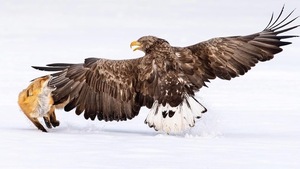


Snapshots of avian life from the cute to the Cretaceous by finalists of the 2021 Bird Photographer of the Year competition.



Snapshots of avian life from the cute to the Cretaceous by finalists of the 2021 Bird Photographer of the Year competition.

Taoiseach Micheál Martin announcing the easing of Covid restrictions last night
Fluffybiscuits writes:
Inter county travel is to be lifted from May 10. When Northern Ireland returns to normal along with rest of UK, does the fact we have no border not mean the government’s hands here are forced to match those measures? Monitoring compliance for people traversing the border would be impossible
Anyone?

Dr Tony Holohan, Chief Medical Officer, Department of Health at a Covid-19 press briefing in the Department of Health this afternoon
‘We are particularly concerned about Donegal,’ says Dr Tony Holohan, as the rates are still very high there. Now there is an opportunity for Donegal to try to reduce the incidence of Covid-19, he says. | Read more: https://t.co/ojWhHCCE87 pic.twitter.com/nuOLw6AD7I
— RTÉ News (@rtenews) April 30, 2021
This afternoon.
“…while the national incidence rate is 125 per 100,000, Donegal currently stands at 295 per 100,000. This is extremely concerning for public health doctors locally.”
Dr Tony Holohan earlier.
Anyone?
Holohan: Easing of restrictions a ‘welcome and deserved turning point’ (Irish Examiner)

Behold: a stunning image of our own shaded planet taken 49 years ago. To wit:
From the unfamiliar perspective, the Earth is small and, like a telescopic image of a distant planet, the entire horizon is completely within the field of view. Enjoyed by crews on board the International Space Station, only much closer views of the planet are possible from low Earth orbit. Orbiting the planet once every 90 minutes, a spectacle of clouds, oceans, and continents scrolls beneath them with the partial arc of the planet’s edge in the distance. But this digitally restored image presents a view so far only achieved by 24 humans, Apollo astronauts who traveled to the Moon and back again between 1968 and 1972. The original photograph, AS17-152-23420, was taken by the homeward bound crew of Apollo 17, on December 17, 1972. For now it’s the last picture of Earth from this planetary perspective taken by human hands.

A few pics from the snow in Kilakee in the Dublin mountains yesterday, thanks to the herald and independent for using pictures today, will we be building snowmen in May! @PPAI_IRL @CarlowWeather @StormHour pic.twitter.com/ohV9X2SLxE
— Damien Eagers (@deagers) April 30, 2021
THIS is warming?
How dare you, Greta.
FIGHT!
Want to know more about the vaccine bonus? Here’s a quick explainer: pic.twitter.com/SIBgquLrlP
— Leo Varadkar (@LeoVaradkar) April 30, 2021
This evening.
Earlier…
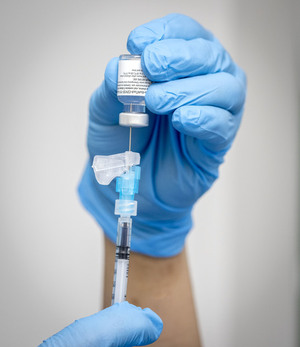
The Pfizer BioNTech COVID-19 vaccine
We’ve just submitted a request for a variation of our Conditional Marketing Authorization to @EMA_News for our #mRNA #COVID19 vaccine to be extended to adolescents 12-15 yrs. https://t.co/hzNS5EW936
— BioNTech SE (@BioNTech_Group) April 30, 2021
This afternoon.
In a joint statement, Pfizer and BioNTech said they had submitted a request with the Amsterdam-based EMA to expand the use of their jab to include “adolescents 12 to 15 years of age”.
Ugur Sahin, co-founder and CEO of Germany’s BioNTech, yesterday said the jab could be available for those age groups from June if EU approval is granted.
Today’s move comes after Phase 3 trial data showed that the vaccine provided “robust antibody responses” and was 100% effective in warding off the disease among those aged 12 to 15.
“The vaccine also was generally well tolerated,” the statement added.
After your teen, etc.
Pfizer asks EMA to authorise jab for 12 to 15-year-olds (RTÉ)


This morning/afternoon.
Phoenix Park, Dublin.
New loos from the Office of Public Works (OPW) situated in the car park opposite the Papal Cross.
Beats using a tree.
I guess.
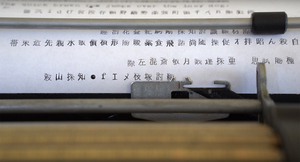


Behold: a rare 1940 index typewriter, the Toshiba BW-2112 – demonstrated here by New Orleans based Typewriter Collector – which uses horizontal cylinders with thousands of symbols to type in Japanese, Chinese and English.
In the mid 50s, when Toshiba switched to a Western style keyboard with Kana characters, the cylinder models were discontinued, making this a rare machine indeed. Of the device, which ordered characters in a manner similar to that found in a Japanese dictionary, Typewriter Collector sez:
They’re arranged phonetically by most common “on-yomi” (or kun-yomi in some cases) according to the kana syllabary (many homophones, of course)… Red characters help parse the readings. Last character to left of equal sign can be pronounced “kin” (exert) and the first character in next row “gin” (silver), then “ku” (suffer) in red followed by “kuu” (sky, empty), “kuma” (bear), “kun” (teachings, meaning [also the kun in kun-yomi]), “gun” (group), then “kei” (system) in red followed many, homophones of “kei”
Now for yiz.