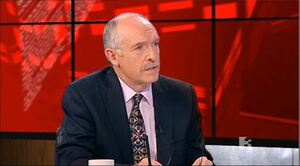
Breda O’Brien of the Iona Institute (top) and Dr Deirdre Madden (UCC)
Earlier, on RTÉ Radio One’s Today with Seán O’Rourke, Seán introduced an item on surrogacy with the following:
Seán O’Rourke: “And that’s Helen Hayes speaking last month about surrogacy. Now after that interview went out we received a call from Breda O’Brien of the Iona Institute expressing concerns about surrogacy. She’s with me now in studio and in our Cork studio, I’m joined by Dr Deirdre Madden, senior lecturer in Medical Law at University College Cork.”
[Later]
Dr Deirdre Madden: “Thus far, there has been no indication that children born through this means [surrogacy] have experienced any psychological problems. I do acknowledge when they do reach adolescence or when they are older that issue may arise. But as I say, for the moment the results are very positive.
Breda O’Brien: “But Deirdre you know those studies have tiny sample numbers, some of them are self-reporting by parents. It’s the parent’s estimation of the difficulties or otherwise of the children.”
Madden: “But this also Breda was introducing the children’s teachers in school and other adult figures in their lives.”
O’Brien: “In some cases the children don’t know as well. In some cases the children weren’t actually aware. I think the best thing we can say about studies is that they’re inconclusive, that they don’t show any evidence one way or the other.”
[Later]
Madden: “I think it is very paternalistic to suggest that women would not be able to enter into this sort of arrangement with full and voluntary consent.”
O’Brien: “In fact, it’s maternalistic. It’s the desire that women would be protected in the situation and the children be protected as well.”
Madden: “Most women don’t actually feel that the children that they’re carrying are their children, particularly but not only where the child is the full genetic child of the intended parents.”
O’Brien: “So you’re thinking of women as vessels then?”
Madden: “No. I’m saying that the women themselves do not consider the child they’re carrying to be theirs.”
O’Brien: “So therefore, they’re just a vessel?”
Madden: “That’s not how they consider it. They consider that they’re giving a wonderful gift to this infertile couple.”
O’Brien: “Which they are but at what price and at what cost and is it not better to follow the example of other European countries? You’re never going to get rid of it completely but you can send out a very strong cultural message that this is not the thing to do.”
Not Breda’s first or probably last time to debate an expert on Radio One.
On last night’s Tonight with Ger Colleran, Ger was joined by Caroline Simons (Pro Life Campaign), Dr Máire Nesta Nic Ghearailt (Every Life Counts), Dr Peter Boylan (National Maternity Hospital Holles St) and Ruth Bowie (TFMR) to discuss abortion in cases of rape, incest and terminations for medical reasons (TFMR).
Ger Colleran: “You’re advocating that the medical or the legal prohibition on termination of such pregnancies [fatal foetal abnormalities] continue?”
Caroline Simons: “I’m advocating that the best position in the interests of women and in the interests of unborn babies is that there be a right to life for both and that the mother inevitably comes first because you cannot fail to look after a mother, without losing a baby as well.”
Former US president Jimmy Carter has called on Ireland to take a lead in introducing legislation to target the buyers of sex.
In letters to the Taoiseach, the Minister for Justice and all members of the Oireachtas, Mr Carter urged politicians to act with a “sense of urgency” to protect prostituted women and girls. In the letters, Mr Carter acknowledges the progress being made in Ireland towards passing legislation that would target the buyers of sex.
Both The Lancet and The Economist have called for prostitution to be decriminalised:
Sweden’s avowed aim is to wipe out prostitution by eliminating demand. But the sex trade will always exist—and the new approach has done nothing to cut the harms associated with it. Street prostitution declined after the law was introduced but soon increased again. When Rhode Island unintentionally decriminalised indoor prostitution between 2003 and 2009 the state saw a steep decline in reported rapes and cases of gonorrhoea. Governments should focus on deterring and punishing such crimes [slavery and child prostituition] and leave consenting adults who wish to buy and sell sex to do so safely and privately online.
No NATO territory is under threat of being violated, other than inside the narrative. Moreover, while voices in Europe increasingly claim that the threat to Ukraine is a threat to Europe (i.e. the EU), Ukraine is no more an EU member than it is a NATO member. Brussels seems to want it to be, but that’s where the narrative ends. So it’s simply being changed on the fly and has now become: “Ukraine is fighting a war on behalf of all Europe”, according Lithuanian leader Dalia Grybauskaite.
Which is where I think: really, Ukraine has killed over 2000 of its own citizens ‘on behalf of Europe’?
Part one (and the recently released part two) of Anita Sarkeesian’s examination of the Women as Background Decoration video game trope – a thing she defines as:
…the subset of largely insignificant non-playable female characters whose sexuality or victimhood is exploited as a way to infuse edgy, gritty or racy flavoring into game worlds.
Writing in yesterday’s Sunday Business Post, Dr Peter Boylan (consultant obstetrician and former Master of the National Maternity Hospital, Holles Street) has called for cross-party support to either repeal or retain the Eighth Amendment:
The vast majority of Irish women who seek abortions do so in the UK. This avenue should not be presumed to be available forever. Growing public awareness in Britain of the extent to which we are exporting our problem, as well as on-going financial constraints in the NHS, make it likely that British hospitals will increasingly restrict access to women from Ireland for termination.
Our current law is governed by the 1983 Eighth Amendment, which provides for the equal right to life of the mother and the unborn. As we saw with the case of Savita, this has resulted in abortion being lawful only where there is a real and substantial risk to the life of the mother.
Obstetricians find this difficult to interpret. Put simply, obstetricians have to decide how close to death a woman has to be before they can intervene and the woman herself has no say in the matter.
Psychiatrists have to assess the risk of suicide. In practice this really only applies to those who are not able to travel, the majority of whom are in the care of the state.
…I suggest that our politicians reach cross-party agreement, as soon as possible, that a referendum – whose sole issue should be the removal or retention of the Eighth Amendment – will be held at a specified date early in the term of the next government. Such political consensus would not bind parties to a particular stance on the referendum to follow, but would take much of the toxicity out of the issue of a referendum itself from the politics of the next general election campaign and lessen the kind of aggressive lobbying to which TDs have been subject in the past.
We can only hope thereafter for a mature, factual, and compassionate debate on this most difficult of subjects. In the meantime, bad law makes hard cases.
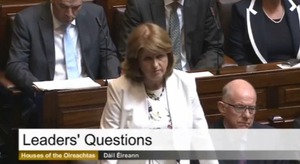
Deputy Catherine Murphy asked the Tánaiste Joan Burton a number of topical questions on the final sitting of the Dáil before the summer recess (July 17) in light of the UN HRC hearings in Geneva.
The Labour Party leader firmly ruled out any hope of new legislation for victims of rape and incest and those seeking terminations for medical reasons (TFMR).
Deputy Catherine Murphy: “This week’s damning review of our human rights practices by the United Nations Human Rights Committee makes for grim reading but it is hardly surprising. Our failure in regard to the Magdalen laundries survivors, the symphysiotomy survivors, those who spent time in mother and baby homes and those who were victims of clerical child abuse is shameful. However, we stand to repeat the mistakes of the past if we do not act to address the grossly discriminatory laws that govern abortion. The UN committee confirmed that we are in breach of the International Covenant on Civil and Political Rights by denying women the option to avail of abortion in certain circumstances, namely, rape, incest, fatal foetal abnormalities and where a woman’s health is in danger. I would argue that we are not only in breach of the covenant but also in breach of basic humanity in denying an abortion to a woman who has been raped, is a victim of incest or has to endure carrying to full term a pregnancy when there is no prospect of delivering a live baby. I found it profoundly chilling to listen to the remarks of the principal officer of the Department of Health who told the committee that denying these women the right to abortion was the will of the people. I question what people are meant. The eighth amendment to the Constitution was inserted more than 30 years ago and attitudes have changed significantly since then, as recent polls have shown.
The Labour Party is a socially progressive party. The Tánaiste is the leader of that party as well as the deputy leader of this country, and she is also one of the few women in a decision-making role in this Government. Is she going to use her powerful position to bring about change in this area and, if so, how is she going to do that?”
Tánaiste: “In regard to the issues arising around fatal foetal abnormalities, the Deputy will be aware that some time ago the Government legislated successfully in regard to the X case. That is reflected in our legislation and is an issue that both parties in Government have addressed. In regard to fatal foetal abnormalities, I am on record as stating that I would like to see a situation where it is possible to address them. As of yet we do not have agreement on that in the programme for Government. It is a personal position and I have been on public record in this regard over a long period.”
Deputy Catherine Murphy: “I know we have legacy issues and it is very uncomfortable to consider past failures in hindsight. We are asking how we allowed such things to happen and who was in power at the time, but will the pattern be repeated by people in power now, and will we have the same conversations in 30 years?”
Deputy John Halligan: “Exactly.”
Deputy Catherine Murphy: “The same committee might then be reviewing how the country dealt with issues like fatal foetal abnormalities, for example, or people who have been raped or subject to incest and who have been denied their human rights. The Tánaiste indicated her personal views are on the record but I ask her as Tánaiste – deputy leader of the country – and the leader of the Labour Party for her position on the issue.
I went to Liverpool Women’s Hospital with people who were part of a study group on fatal foetal abnormalities. People were put through a tortuous process where, for example, they would have had to retrieve the remains of a baby they wanted by way of something like DHL delivery, which is absolutely appalling. It is inhumane and we cannot rely on a 31 year old referendum decision, presuming that people have not moved on when so many events have taken place in this country. We need a referendum, as the Tánaiste knows, if we are to change that position. Does the Tánaiste accept we need a referendum and will she commit to working towards such a referendum?”
Tánaiste: “There has been an extensive process with the Constitutional Convention, which considered various issues and reported findings. As I pointed out, the Government and the Dáil has dealt with issues arising from the X case. Those had been unresolved over a very long period of years. We want a position in Ireland where every baby is a wanted baby. The Deputy spoke about cases and the people she accompanied in Liverpool, and those are tragic circumstances as the babies are wanted but their life outcomes were in doubt because of medical issues.
It was referenced in Geneva that on a previous occasion, the Irish people gave a view – as was their entitlement – on what they wanted reflected in the Constitution. I did not share the view at the time and my party and others like me recommended voting against the amendment to the Constitution. As a democrat, the Deputy must recognise that the people voted for the eighth amendment to the Constitution. The Government has legislated for and dealt with issues surrounding the X case, which has been a difficult issue in this country over a very long period. That is what was agreed in the programme for Government.”
Deputy John Halligan: “So the Tánaiste will not agree to a new referendum.”
Norwegian artist Markus Moestue is currently travelling across Norway on his homemade Frankenbike complete with polystyrene-carved velociraptor chassis. And were you to stop him and ask why, he would tell you that he’s built it…
…for a trip across the bible belt in Norway. it’s a protest against the dogmatic religious education of children, and the idea originated from the theme-parks of creationists that teach children that humans and dinosaurs used to live together.




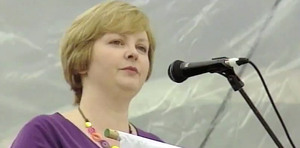
 Breda O’Brien of the Iona Institute (top) and Dr Deirdre Madden (UCC)